

ADR tunnel restrictions
Check whether a load may pass, find the tunnel on the map and read what each country has notified. Official sources only.
Tunnel category
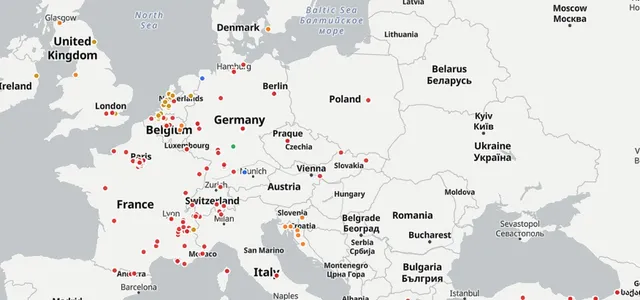
350 tunnels · 23 countriesTunnel categories A–E
No restriction
every dangerous good may pass. These tunnels carry no ADR tunnel sign.
Official ADR wording
No restrictions for the carriage of dangerous goods.
Closed to loads that could cause a very large explosion
mainly large quantities of explosives and certain reactive gases, organic peroxides and self-reactive substances. Marked with a 'B' sign.
Official ADR wording
Restriction for the carriage of dangerous goods which may lead to a very large explosion. Goods deemed to meet this criterion: Class 1 compatibility groups A and L; Class 2 UN 3529; Class 3 classification code D (UN 1204, 2059, 3064, 3343, 3357, 3379); Class 4.1 codes D and DT and self-reactive substances type B (UN 3221, 3222, 3231, 3232); Class 5.2 organic peroxides type B (UN 3101, 3102, 3111, 3112). When net explosive mass per transport unit > 1000 kg: Class 1 Divisions 1.1, 1.2, 1.5 (except groups A and L). When carried in tanks: Class 2 codes F, TF, TFC; Class 4.2 PG I; Class 4.3 PG I; Class 5.1 PG I; Class 6.1 UN 1510.
Closed to loads that could cause a large or very large explosion, or a major toxic release
toxic and oxidising goods on top of category B. Marked with a 'C' sign.
Official ADR wording
Restriction for the carriage of dangerous goods which may lead to a very large explosion, a large explosion or a large toxic release. Covers all goods restricted in category B, plus: Class 1 Divisions 1.1, 1.2, 1.5 (except groups A and L) and Division 1.3 (groups H and J); Class 7 UN 2977 and 2978. When net explosive mass per transport unit > 5000 kg: Class 1 Division 1.3 (groups C and G). When carried in tanks: Class 2 codes 2A, 2O, 3A, 3O and codes with letter T only or letter groups TC, TO, TOC; Class 3 PG I for codes FC, FT1, FT2, FTC; Class 6.1 PG I except UN 1510; Class 8 PG I for codes CT1, CFT, COT.
Closed to loads that could also cause a large fire
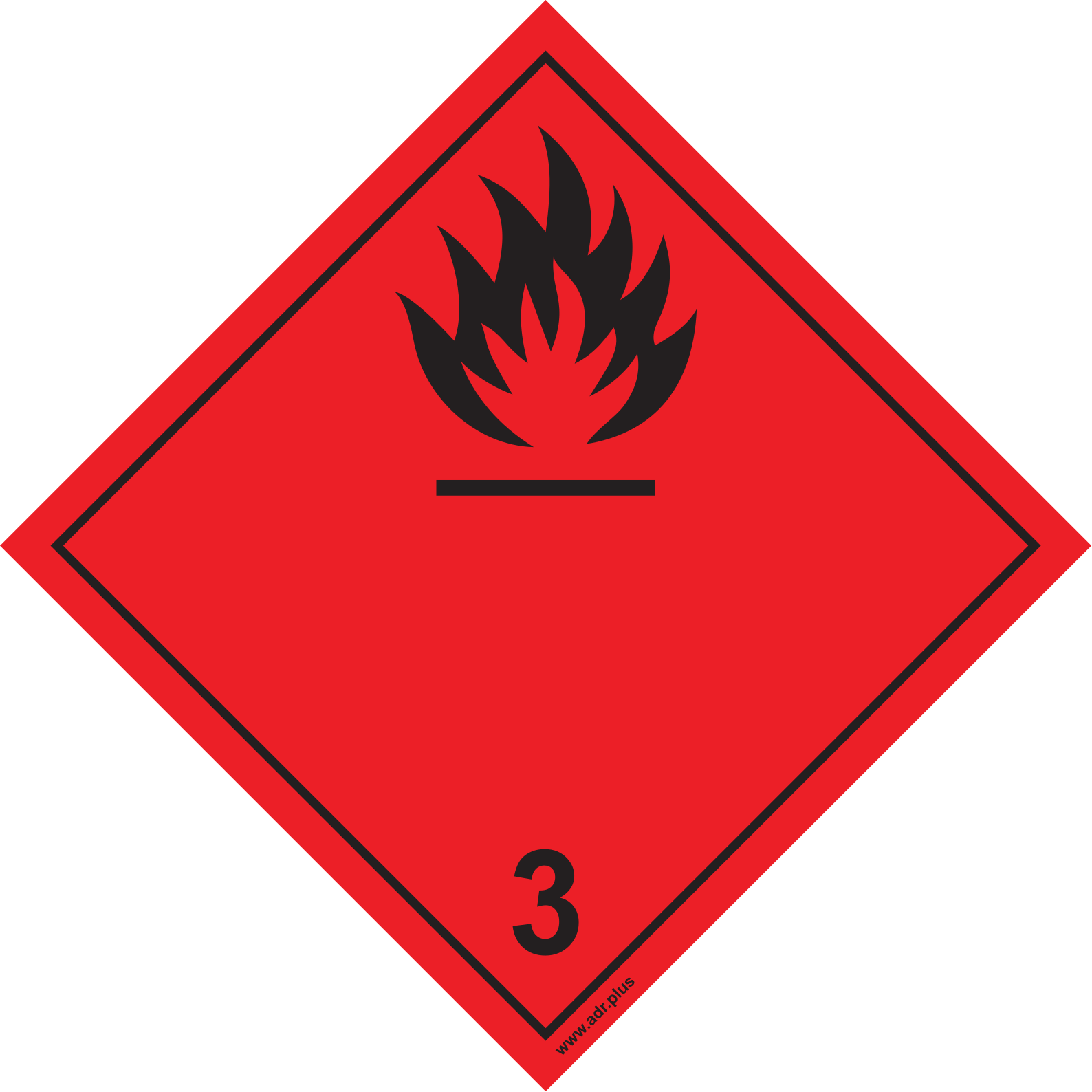
most flammable liquids and gases, on top of category C. Marked with a 'D' sign.
Official ADR wording
Restriction for the carriage of dangerous goods which may lead to a very large explosion, a large explosion, a large toxic release or a large fire. Covers all goods restricted in category C, plus: Class 1 Division 1.3 (groups C and G); Class 2 codes F, FC, T, TF, TC, TO, TFC, TOC; Class 3 UN 3528; Class 4.1 self-reactive substances types C, D, E, F and UN 2956, 3241, 3242, 3251, 3531, 3532, 3533, 3534; Class 5.2 organic peroxides types C, D, E, F; Class 6.1 PG I for codes TF1, TFC, TFW and UN 3507, plus toxic-by-inhalation entries with special provision 354 and UN 3381 to 3390; Class 8 PG I for codes CT1, CFT, COT; Class 9 codes M9 and M10. When carried in bulk or in tanks: Class 3; Class 4.2 PG II; Class 4.3 PG II; Class 6.1 PG II and PG III for code TF2; Class 8 PG I for codes CF1, CFT, CW1 and PG II for codes CF1, CFT; Class 9 codes M2 and M3.
The strictest
closed to almost all dangerous goods, except a short listed set and small limited-quantity loads. Marked with an 'E' sign.
Official ADR wording
Restriction for the carriage of all dangerous goods other than those for which '(-)' is marked in column (15) of Table A of Chapter 3.2, and for all dangerous goods in accordance with the provisions of Chapter 3.4 (limited quantities) if the quantities carried exceed 8 tonnes total gross mass per transport unit. NOTE: for goods assigned to UN 2919 and 3331, tunnel-passage restrictions may instead form part of a special arrangement approved by the competent authority on the basis of 1.7.4.2.
National bans and regimes without an ADR category
Some countries restrict or close a tunnel to dangerous goods without assigning any A–E category. Such tunnels carry a neutral marker on the map and in the table — the restriction is real, the category letter does not exist. Its scope and hours follow the national document — please read it before planning a route.
Three rules before the trip
Orange-coloured plates
ADR 8.6.4 · 5.3.2
Tunnel restrictions apply to transport units for which orange-coloured plate marking is required under 5.3.2 (ADR 8.6.4).
Limited quantities
ADR 8.6.4 · 3.4.13
Units marked for limited quantities under 3.4.13 are barred only from category E tunnels. Containers marked under the IMDG Code with up to 8 t of such packages are exempt (8.6.4, Note 2).
The 1.1.3.6 exemption
ADR 1.1.3.6.2
Within the 1.1.3.6 small-quantity exemption Chapter 5.3 does not apply, so the tunnel restrictions do not apply either.
Open the 1.1.3.6 calculatorCountries without notified tunnel categories
These ADR countries have notified no tunnel restrictions under 1.9.5. The three groups show what official sources confirm for each of them.
Checked, no tunnel restrictions found
The 1.9.5 notification is empty and the national acts we read contain no restriction for tunnels.
- Azerbaijan
- Belarus
- Bosnia and Herzegovina
- Bulgaria
- Estonia
- Finland
- Georgia
- Hungary
- Latvia
- Lithuania
- Malta
- Moldova
- Morocco
- North Macedonia
- Romania
- San Marino
- Serbia
- Ukraine
A national rule applies
Kazakhstan
National rules in force since 25 April 2026 apply ADR 1.9.5.2.2 to passage through category E tunnels. The act names no tunnel.
Official source ↗Slovenia
Karavanke tunnel on the border with Austria. Amber warning lamp, 150 m distance and an escort vehicle for the most hazardous goods. On the map the tunnel is listed under Austria.
Official source ↗Uzbekistan
National rules let vehicles carrying dangerous goods pass a tunnel one vehicle at a time.
Official source ↗
No notification, check the national rules
There is no official list or it could not be opened. Before the trip, ask the competent authority of the country.
- Albania
- Armenia
- Cyprus
- Kyrgyzstan
- Liechtenstein
- Montenegro
- Nigeria
- Russia
- Tajikistan
- Tunisia
- Uganda
Checked against official sources on 1 October 2026