



A dangerous goods consignment passes through many hands on its way to the destination, and ADR does not hang safety on any single pair of them. Chapter 1.4 names every participant in the carriage and gives them all one general duty — take appropriate measures according to the nature and the extent of foreseeable dangers, so as to avoid damage or injury and, if necessary, to minimize their effects — and, in all events, comply with the requirements of ADR in their respective fields (ADR 1.4.1.1). Below that umbrella the chapter divides the roles in two — the main participants (consignor, carrier and consignee) and the other participants — loader, packer, filler and unloader among them, each with its own checklist.
Consignor — nothing leaves that does not conform
The consignor may hand over for carriage only consignments which conform to the requirements of ADR (ADR 1.4.2.1.1). In particular, the consignor shall do the following.
- ascertain classification — the goods are classified and authorized for carriage in accordance with ADR (ADR 1.4.2.1.1).
- furnish the carrier with information and data in a traceable form, plus the required transport and accompanying documents — authorizations, approvals, notifications, certificates (ADR 1.4.2.1.1).
- use only approved packagings, large packagings, IBCs and tanks that are suited to the substances concerned and bear the marks prescribed by ADR (ADR 1.4.2.1.1).
- comply with the requirements on the means of dispatch and on forwarding restrictions (ADR 1.4.2.1.1).
- treat empty uncleaned tanks like loaded ones — placarded, marked and labelled in accordance with Chapter 5.3, closed and presenting the same degree of leakproofness as if they were full (ADR 1.4.2.1.1).
Carrier — check before the wheels turn
The carrier is the counterweight — before carriage begins, the carrier shall in particular (ADR 1.4.2.2.1) do the following.
- ascertain the goods are authorized for carriage in accordance with ADR.
- ascertain the documentation is on board — all information prescribed in ADR has been provided by the consignor, and the prescribed documents travel on the transport unit (or their electronic equivalent is available throughout the journey).
- check visually that the vehicles and loads have no obvious defects, leakages or cracks and no missing equipment.
- check tank inspection dates — the date specified for the next inspection of tank-vehicles, battery-vehicles, demountable tanks, portable tanks, tank-containers and MEGCs has not expired.
- verify the vehicles are not overloaded.
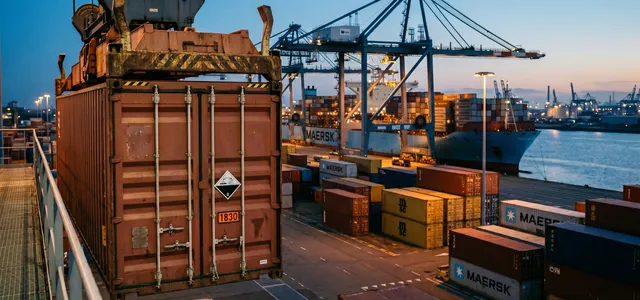
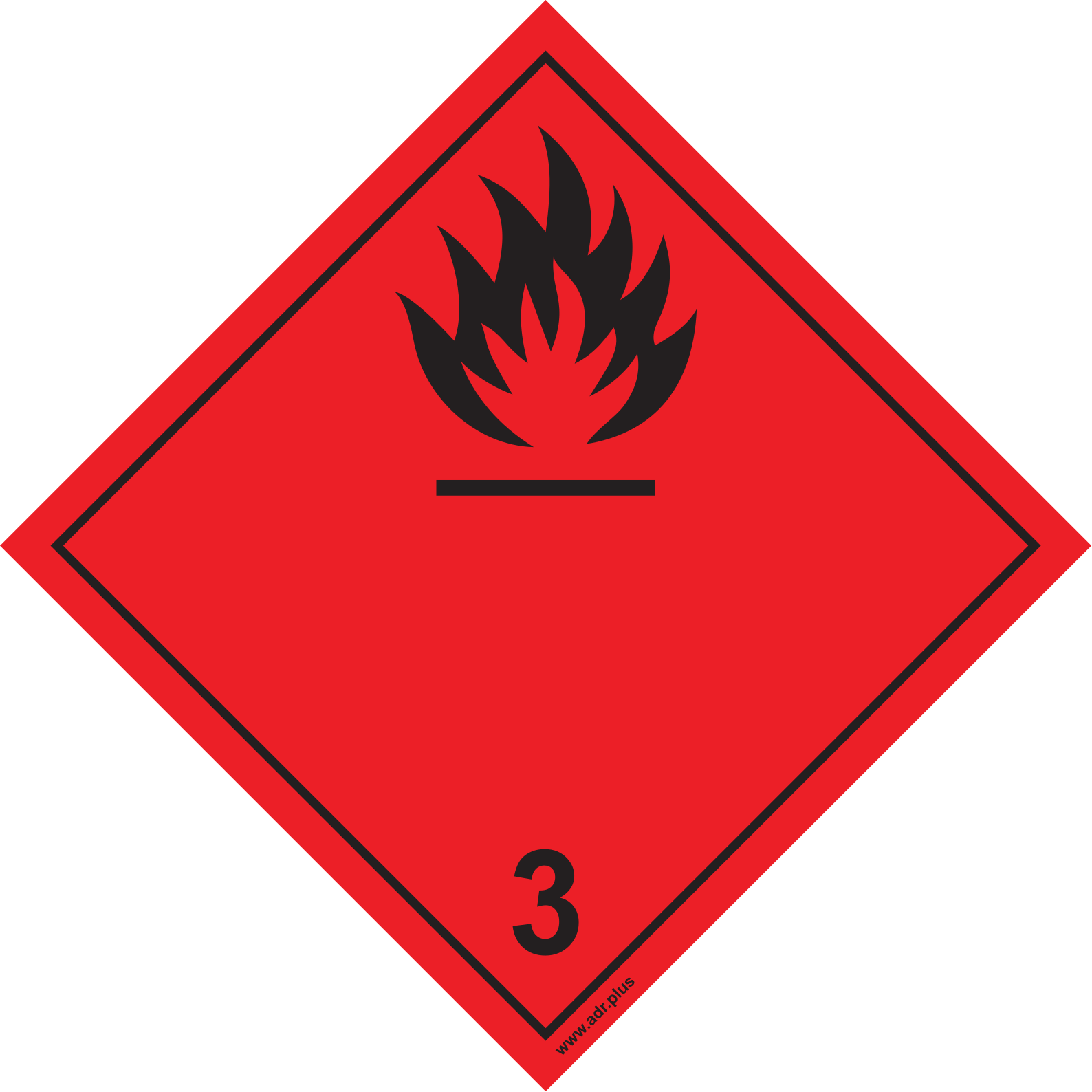
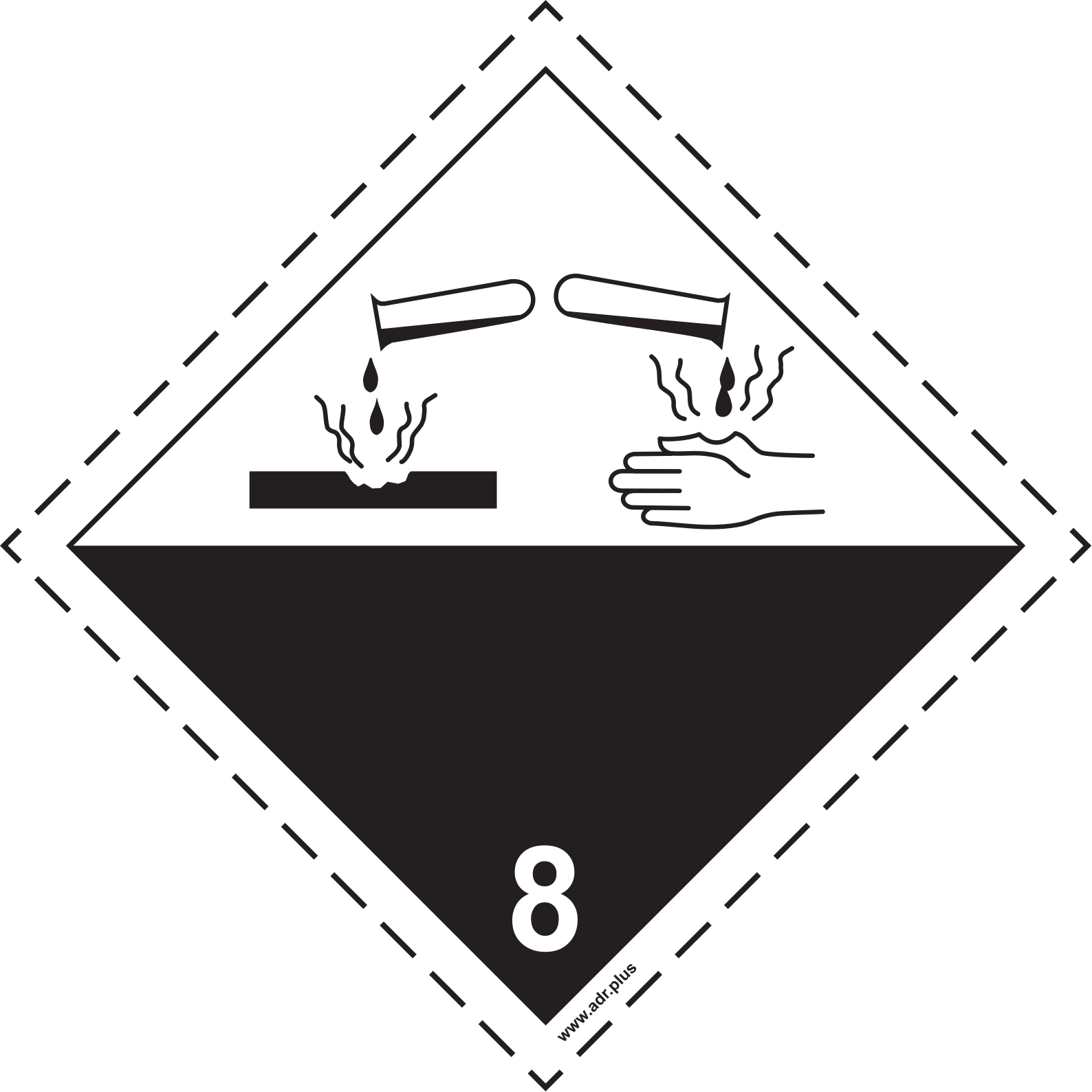
- ascertain placards, marks and orange-coloured plates prescribed in Chapter 5.3 are affixed, and the equipment prescribed for the transport unit, the vehicle crew and certain classes is on board.
Where appropriate, these checks are made on the basis of the transport documents and by visual inspection of the vehicle, the containers and the load (ADR 1.4.2.2.1).
Consignee — the shortest checklist, still a real one
The consignee has two obligations — not to defer acceptance of the goods without compelling reasons, and to verify, after unloading, that the requirements of ADR concerning the consignee have been complied with (ADR 1.4.2.3.1). Short — but it means the receiving side cannot simply let a vehicle wait at the gate indefinitely, and it remains answerable for its own part of the rules once the goods are off the vehicle.
Loader — the gatekeeper at the ramp
The loader shall in particular (ADR 1.4.3.1.1) do the following.
- hand the dangerous goods over to the carrier only if they are authorized for carriage in accordance with ADR.
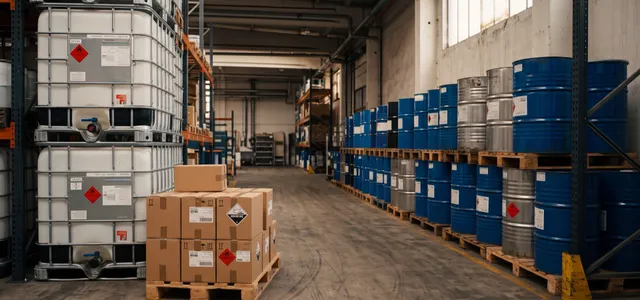
- check packagings for damage — a package whose packaging is damaged, especially if it is not leakproof, is not handed over until the damage has been repaired. The same applies to empty uncleaned packagings.
- comply with the special requirements concerning loading and handling.
- after loading dangerous goods into a container, comply with the requirements on placarding, marking and orange-coloured plates conforming to Chapter 5.3.
- observe the prohibitions on mixed loading, taking into account goods already in the vehicle or large container, and the requirements on separation from foodstuffs, other articles of consumption and animal feedstuffs.
Packer — conditions, marks, labels
The packer shall comply in particular with the requirements concerning packing conditions and mixed packing conditions, and — when preparing packages for carriage — with the requirements concerning marking and labelling of the packages (ADR 1.4.3.2). Two lines in the regulation, but they carry the whole of the packing rules — the wrong combination of substances in one box or a missing label is the packer’s failure.
Filler — the longest checklist of all
Whoever fills a tank takes on the most detailed list in the chapter. The filler shall in particular (ADR 1.4.3.3) do the following.
- ascertain before filling that the tank and its equipment are technically in a satisfactory condition, and that the tank’s next inspection date has not expired.
- fill the tank only with dangerous goods authorized for carriage in that tank.
- comply with the requirements on dangerous goods in adjoining compartments, and observe the permissible degree of filling, filling ratio or mass of contents per litre of capacity for the substance.
- after filling, ensure all closures are closed and there is no leakage, and that no dangerous residue adheres to the outside of the tank.
- ensure the placards, marks, orange-coloured plates and labels are affixed to tanks, vehicles and containers for carriage in bulk in accordance with Chapter 5.3, and — for bulk filling — that the provisions of Chapter 7.3 are complied with.
Unloader — the mirror image of the loader
The unloader closes the chain (ADR 1.4.3.7.1).
- ascertain that the correct goods are unloaded by comparing the transport document with the information on the package, container, tank or vehicle.
- before and during unloading, check whether the packagings, tank, vehicle or container are damaged to an extent that would endanger the operation — and stop until appropriate measures have been taken.
- comply with the requirements concerning unloading and handling.
- immediately after unloading a tank, vehicle or container, remove dangerous residues from the outside and ensure the closure of valves and inspection openings.
- ensure the prescribed cleaning and decontamination is carried out — and that fully unloaded, cleaned and decontaminated containers no longer display the placards, marks and orange-coloured plates of Chapter 5.3.
What this means in practice
The roles in Chapter 1.4 attach to activities, not to company names — so one company routinely carries several of them at once. A warehouse that receives and dispatches dangerous goods is both loader and unloader. A chemical plant that packs its products and fills its own tank-containers is consignor, packer and filler in the same shipment. Each role brings its own checklist, and the checklists do not merge or cancel out — the company answers for all of them in parallel. The practical consequence is that “we only ship it” is rarely true — before assigning responsibility, map which Chapter 1.4 activities actually happen at your site.
Two things hold this construction together. First, training — everyone involved in the carriage of dangerous goods must be trained for their duties in accordance with Chapter 1.3 — office staff who prepare transport documents included, not just drivers. Second, allocation — it is the job of the company’s ADR consultant to translate Chapter 1.4 into internal instructions, so that every role knows its part of the checklist before the vehicle arrives at the ramp.
References — ADR 2025 1.4.1.1 (general duty of all participants), 1.4.2.1.1 (consignor), 1.4.2.2.1 (carrier), 1.4.2.3.1 (consignee), 1.4.3.1.1 (loader), 1.4.3.2 (packer), 1.4.3.3 (filler), 1.4.3.7.1 (unloader).