
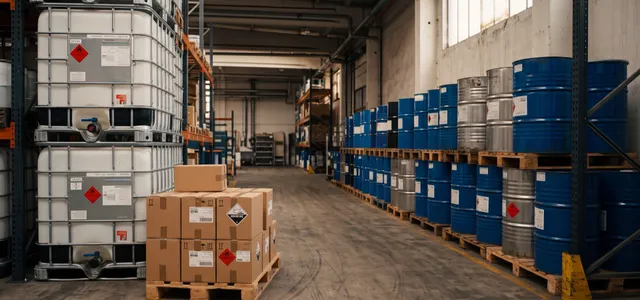
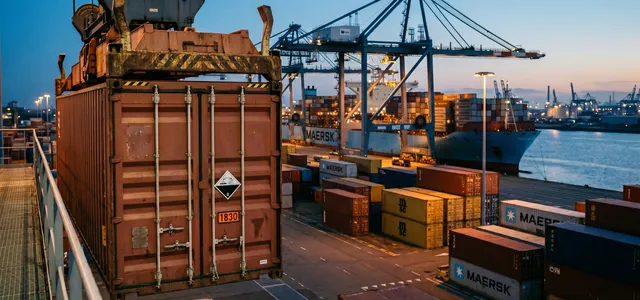




Dangerous goods — from a tanker of fuel to a pallet of lithium batteries — move by road under a single European framework, the ADR agreement. Its starting point is simple — everyone involved in the transportation of dangerous goods must take measures appropriate to the nature and extent of the foreseeable dangers, so as to avoid damage or injury and, where that fails, to minimise the effects (ADR 1.4.1.1). This article is a map of what ADR asks for, step by step — who is responsible for what, which documents, packaging and training are needed, when a business must appoint an ADR consultant, and when a load can travel under lighter rules. Rail carriage runs under a parallel agreement, RID. Here we deal only with road transport.
What ADR covers
Annex A of ADR sets out which dangerous goods are barred from international carriage and which are authorised and on what conditions — classification and its criteria, the use of packagings and tanks, consignment procedures (marking and labelling of packages, placarding and marking of vehicles, and the required documentation), the construction and testing of packagings and tanks, and the use of vehicles, including loading and unloading (ADR 1.1.2.1). The agreement is organised into nine parts — Parts 1 to 7 (Annex A) deal with the goods, Parts 8 and 9 (Annex B) with the crew and the vehicle (ADR 1.1.1).
Who is involved and what they are responsible for
ADR assigns duties by role (Chapter 1.4). Three participants carry the core obligations.
- The consignor hands over for carriage only a consignment that conforms to ADR — it ascertains that the goods are classified and authorised for carriage, gives the carrier the required information and transport documents, and uses only approved packagings and tanks that are suited to the goods and bear the marks ADR prescribes (ADR 1.4.2.1.1).
- The carrier, where appropriate, checks that the goods are authorised for carriage, that the prescribed documents are on board the transport unit, that the vehicle and load show no obvious defects or leaks, that the vehicle is not overloaded, that the placards, marks and orange plates are in place, and that the prescribed equipment is on board (ADR 1.4.2.2.1).
- The consignee must not defer acceptance of the goods without compelling reasons and, after unloading, verifies that the requirements of ADR concerning it have been met (ADR 1.4.2.3.1).
Other participants have duties too — the loader, packer, filler, unloader and the tank-container or portable tank operator (ADR 1.4.3). Several of these roles often sit inside one and the same enterprise (ADR 1.4.2, Note 1). That enterprise then carries the obligations of each role within its own field of activity (ADR 1.4.1.1).
Hazard classes
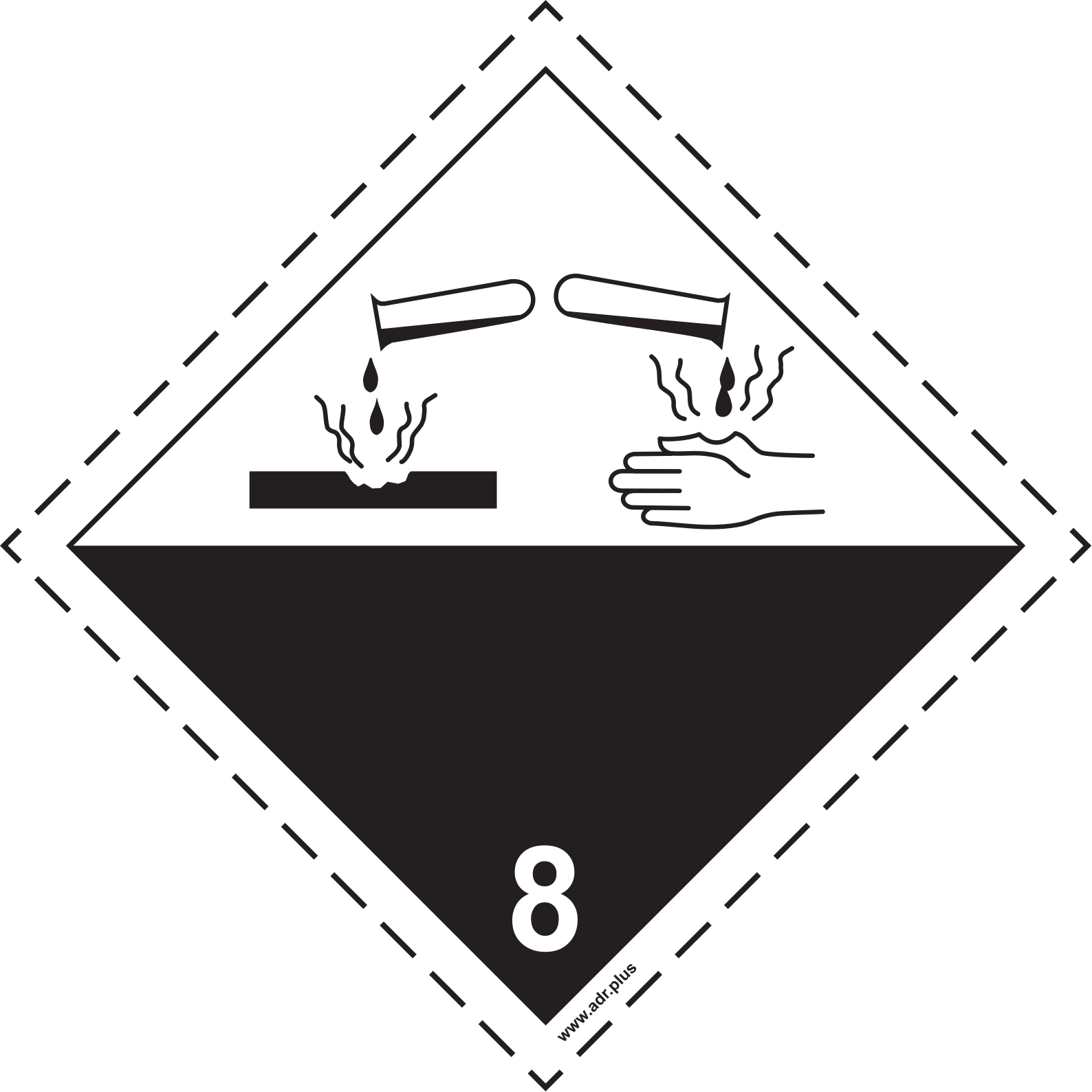
Every dangerous substance or article is first classified into one of the thirteen ADR hazard classes. The numbering runs from 1 to 9, but classes 4, 5 and 6 each cover several separate classes (4.1–4.3, 5.1–5.2, 6.1–6.2), so there are thirteen in all — from Class 1 explosive substances and Class 2 gases, through Class 3 flammable liquids and Class 8 corrosive substances, to Class 9 miscellaneous dangerous substances and articles, which is where lithium batteries sit (ADR 2.1.1.1). The class and UN number drive everything downstream — packaging, marking, documents and any exemptions. Each class is described in the hazard classes overview, and how the assignment itself is done in the classification procedure.
Documents in the cab
Every consignment travels with a transport document. For each dangerous substance it states the UN number preceded by the letters “UN”, the proper shipping name, the hazard label numbers (or, depending on the goods, the class or classification code), the packing group where one is assigned, the number and description of packages where applicable, the total quantity, and the consignor and consignee. Where the route passes through tunnels with restrictions, it also carries the tunnel restriction code (ADR 5.4.1.1.1). How each field is filled in is covered in the transport document article, and the preparation can be handed to a consultant — the cargo instruction and the ADR transport document.
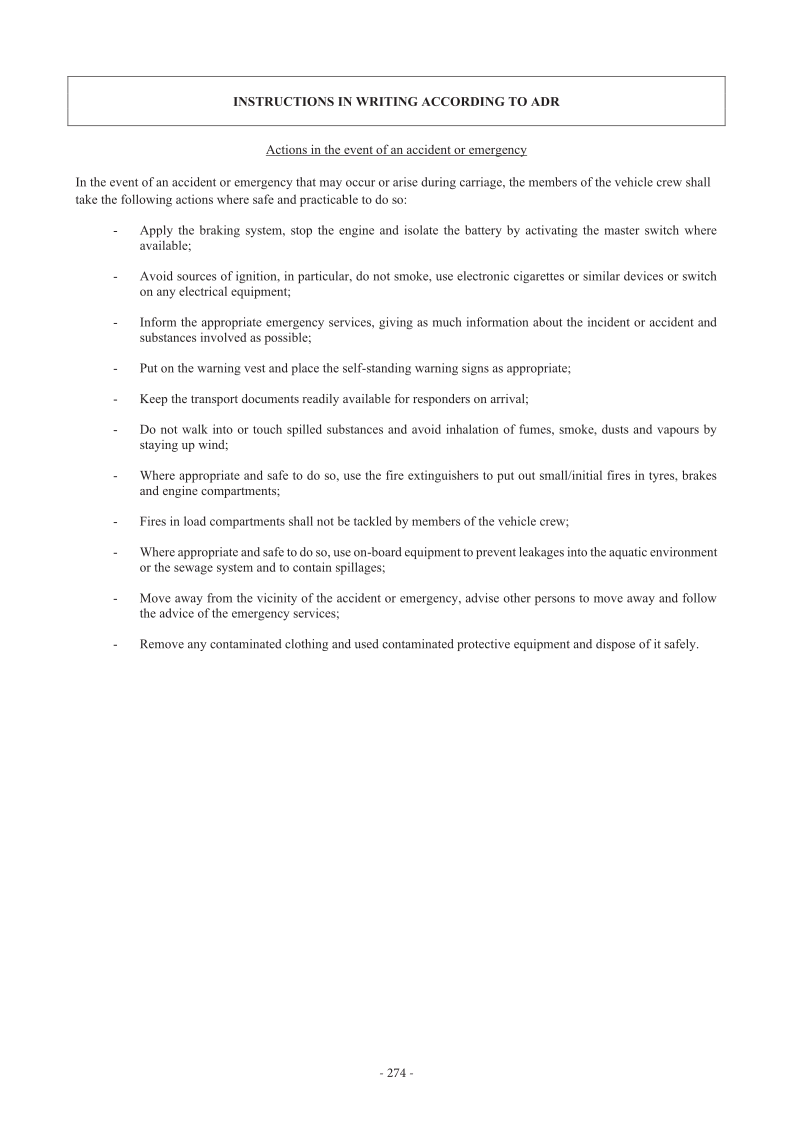
The second mandatory document is the instructions in writing — a four-page emergency aide-mémoire for the crew (ADR 5.4.3.4), kept readily available in the cab (ADR 5.4.3.1). The carrier provides them before the journey starts, in language(s) each crew member can read and understand (ADR 5.4.3.2). The cab must also hold the transport documents covering all the dangerous goods carried and a photo means of identification for each crew member (ADR 8.1.2.1). More detail in written instructions.
Packaging, marking and labelling
Dangerous goods are packed in good-quality packagings strong enough to withstand the shocks and loads of normal carriage, constructed and closed so that nothing escapes under the vibration, temperature, humidity or pressure changes of an ordinary journey. No dangerous residue may cling to the outside (ADR 4.1.1.1). Which packaging is allowed for which substance is set by Part 4 — see packaging and packing groups.
Each package is marked, clearly and durably, with the UN number preceded by the letters “UN” (ADR 5.2.1.1), and carries the hazard labels shown in Column (5) of Table A, unless a special provision in Column (6) provides otherwise (ADR 5.2.2.1.1). More on this in marking of packages, labelling and orange plates and hazard label models.
Vehicle and crew
A transport unit carrying dangerous goods displays two rectangular orange plates, one at the front and one at the rear, set vertically and perpendicular to its long axis (ADR 5.3.2.1.1). Tanks and bulk loads may carry additional numbered plates, covered in labelling and orange plates and placards and vehicle marking. The transport unit carries equipment for general and personal protection, selected according to the danger label numbers of the goods loaded (ADR 8.1.5.1) — the full kit is set out in emergency equipment.
The driver holds a certificate issued by the competent authority confirming that they have taken a training course and passed an examination (ADR 8.2.1.1). That certificate is valid for five years (ADR 8.2.2.8.2). Training is not limited to the driver — everyone whose duties concern the carriage of dangerous goods — loading and unloading staff, and personnel of the consignor and carrier — is trained under Chapter 1.3 (ADR 8.2.3). See the driver’s ADR certificate, driver obligations and training categories.
When you need an ADR consultant
Every undertaking whose activities include consigning or carrying dangerous goods by road — or the related packing, loading, filling or unloading — must appoint one or more safety advisers for the carriage of dangerous goods (the DGSA) (ADR 1.8.3.1). The rule reaches beyond hauliers — a consignor is caught by it even without a vehicle of its own. Competent authorities may exempt undertakings whose quantities per transport unit stay within the limits of 1.1.3.6, 1.7.1.4 and Chapters 3.3 to 3.5, or which only occasionally handle dangerous goods of little danger in national transport (ADR 1.8.3.2).
The adviser’s job is to monitor compliance, advise the undertaking and prepare an annual report for management. The report is kept for five years (ADR 1.8.3.3). The adviser must hold a vocational training certificate issued by the competent authority (ADR 1.8.3.7). The full list of duties is in ADR consultant duties. If you are not sure whether your operation needs one, the ADR consultant service begins with exactly that assessment.
Exemptions for small quantities
Not every consignment carries the full weight of ADR. Where dangerous goods are carried in packages and the quantity on the transport unit stays within the limit for its transport category, a large share of the heaviest requirements falls away — in particular the placarding and orange plates (Chapter 5.3), the instructions in writing (Section 5.4.3), most of Part 8 including the driver’s certificate, and Part 9 (ADR 1.1.3.6.2). This relief is only for goods in packages — it does not reach tanks or goods carried in bulk. Nor does it switch off classification, packaging or labelling — those still apply, and the transport document stays mandatory.
The limit is set by transport category — 20, 333 or 1000 kg or litres for categories 1, 2 and 3 respectively, unlimited for category 4, while category 0 gets no exemption at all (ADR 1.1.3.6.3). When goods of different categories travel together, the quantities are converted to points and the sum may not exceed 1000 (ADR 1.1.3.6.4) — the quickest check is the 1.1.3.6 calculator and the worked 1.1.3.6 explainer. A separate regime covers goods packed in limited quantities — Chapter 3.4 frees them from most other ADR provisions (ADR 3.4.1). See also limited quantities and excepted quantities.
The transportation of dangerous goods is not one requirement but a chain — classification, packaging and labelling, documents, the vehicle and the crew. Break any link and a specific participant answers for it under Chapter 1.4. If you want that whole chain reviewed in your own operation, an ADR consultant starts with an audit of what you actually do and tells you what is really missing.
Sources — ADR 2025 1.1.1–1.1.2.1 (scope and structure), 1.4.1.1 (general safety duty), 1.4.2–1.4.3 (participants), 2.1.1.1 (classes), 4.1.1.1 (packaging), 5.2.1.1 and 5.2.2.1.1 (package marking and labelling), 5.3.2.1.1 (orange plates), 5.4.1.1.1 (transport document), 5.4.3 (instructions in writing), 8.1.2.1 (documents in the cab), 8.1.5.1 (equipment), 8.2.1.1 and 8.2.2.8.2 (driver certificate), 8.2.3 (training of other persons), 1.8.3.1–1.8.3.7 (safety adviser), 1.1.3.6 (small-load exemption), 3.4.1 (limited quantities).