





The cargo instruction and the ADR transport document
You do not need to master ADR — you need to know what to do. Send the safety data sheet and the packing list with the packaging details, and we prepare a short PDF instruction for your cargo with the ready transport document entry — from classification to what you show at a check.
The entry is mandatory, but it does not explain what to do
ADR 5.4.0.1 requires a transport document for every load under ADR, and 8.1.2.1 puts it first in the cab. Yet the entry alone helps little when nobody in the company works with ADR daily — what matters is how to pack, mark and hand over the cargo. We deliver both in one PDF, and it all starts with classification — the UN number and the packing group decide which of the three carriage regimes applies.
Limited quantities (LQ)
Small inner packagings within the column 7a limit, up to 30 kg gross — the goods travel with the LQ diamond, free of most other ADR provisions (Chapter 3.4).
Partial exemption (1.1.3.6)
Below the transport category threshold per transport unit — no orange plates, no written instructions, no ADR driver certificate (the list in 1.1.3.6.2).
Full ADR
Above the thresholds the goods travel under the full set of rules — transport document, plates and labels, equipment, trained crew and every participant duty.
A worked example — viscous paint
The same paint, UN 1263, packing group II. Four ways it can travel — the difference is classification and packaging.
Viscous, flash point 23–60 °C, receptacles up to 450 l
Meets the viscous-liquid conditions of 2.2.3.1.5.1 — outside ADR altogether.
Inner packagings up to 5 l
Limited quantities — the LQ diamond and Chapter 3.4 instead of the full set (column 7a limit).
Jerricans of 20 l, up to 333 l per transport unit
Partial exemption 1.1.3.6 — transport category 2, no orange plates and no ADR certificate.
The same jerricans, above 333 l
Full ADR — transport document, orange plates, equipment, trained driver.
This is what the instruction settles for your cargo — before the goods are on the ramp.
What is inside the PDF
A minimal document your logistics, warehouse and driver can work from — even if they hear about ADR for the first time.
The transport document entry is already inside
UN 1263, PAINT, 3, PG II, (D/E)
The example entry under 5.4.1.1.1 — paint UN 1263, packing group II. Yours comes ready the same way — copy it into the consignment note or the CMR.
- Classification — the UN number, the class, the packing group
- The carriage regime with rationale — LQ, 1.1.3.6 or full ADR
- The ready 5.4.1.1.1 entry for the transport document
- Packing, marks and labels on the packages
- What to hand the driver and what must be in the cab
- A documented rationale you can show at a check
How it works
- 01
Send the safety data sheet and packing list
They show the composition, the packagings and the quantities. If there is no packing list, a short description of how the product ships is enough.
- 02
We classify the cargo and prepare the instruction
Against the criteria of Part 2 and the Table A entry that fits — the UN number, the regime with rationale, the entry for the document and the order of actions for your people.
- 03
You receive the PDF and ship by it
The instruction stays with you — for the next shipments of the same cargo and for your audits.
Pricing
The price applies to a cargo with a ready safety data sheet. Send the documents — the proposal arrives within one working day.
Cargo instruction with the transport document entry
from€50
What the price covers
- Review of the safety data sheet and packaging data
- Cargo classification — the UN number, the packing group, the labels
- The carriage regime with rationale — LQ, 1.1.3.6 or full ADR
- The ready 5.4.1.1.1 entry for the transport document
- The order of packing, marking and loading
- A PDF you can show to the carrier and the inspector
An operational instruction for the company
from €100
A standing process without a subscription — a warehouse, a site or a regular route. A one-off instruction for it, the price depends on the scope.
Sea shipments
€50
For the sea leg we prepare the dangerous goods declaration (DGD) under the IMDG Code — a separate service next door.
DGD declarationPrices excl. VAT. Non-standard cases — mixtures without data, waste, new products — are agreed separately in the proposal.
Questions about the instruction and the document
Short answers with the ADR references. Anything specific to your cargo — ask directly.
Have a different question?
Contact the consultantWho is responsible for the transport document?
The consignor. Under ADR 1.4.2.1.1 the consignor must ascertain that the goods are classified and authorized for carriage, and that the carriage is accompanied by the prescribed documents — even when the UN number came from a supplier.
Is the safety data sheet enough?
Section 14 of the SDS is the starting point, not the answer. Formulations change, sheets age, and the carriage conditions — packing group variants, special provisions, tunnel codes — often are not there. We verify against Part 2 and Table A.
How is this different from the written instructions of 5.4.3?
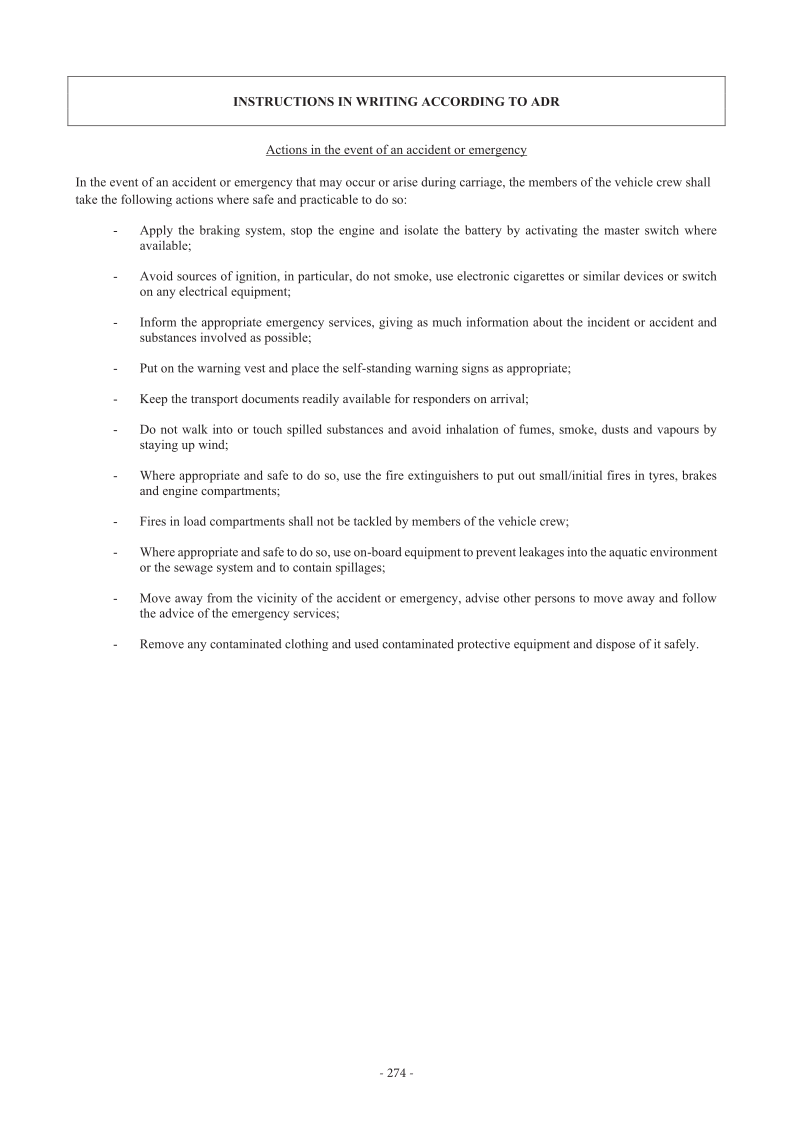
The written instructions under 5.4.3 are the emergency sheet for the vehicle crew in the standard form — the carrier hands them to the crew before the journey, and they must be in the cab. The cargo instruction is the operational document of the consignor. Inside it — how the cargo is classified, how to pack and mark it and which entry goes into the transport document. These are different documents — the printed written instructions are available in our shop.
Several positions in one vehicle?
The instruction covers every position of the carriage. We also calculate the 1.1.3.6 totals for the whole load — so the regime is determined for the vehicle, not only for a single product.
What if the product turns out not dangerous?
That is a result too. You get a documented rationale that the product is outside ADR — it removes the questions of carriers and inspectors just as well.
The formulation changed — do we redo the instruction?
Yes. The instruction is valid for the cargo it describes — a new formulation, packaging or ADR edition calls for a re-check. With the ADRplus One subscription your consultant tracks this for you.
How fast can we start?
Send the safety data sheets and the packing list — the proposal with the price and timeline comes back within one working day.
Send the cargo documents
The safety data sheet and the packing list are enough. Within one working day you get a proposal with the price and the timeline.