



Explosives and ammunition — a security plan from the first kilogram
Shells, cartridges, blasting explosives, detonators, fireworks — Class 1 is the only class where ADR sets no threshold. For packages of divisions 1.1, 1.2, 1.3C, 1.5 and 1.6 the security plan is mandatory in any quantity, for every participant in the carriage — plant, supplier, warehouse, carrier. We develop the plan, instructions and training around your goods and routes and implement them with you.
By 2028 new ammunition and explosives plants start up across Europe — and with them dozens of suppliers, warehouses and carriers facing ADR duties for the first time.
This is what you already ship
Typical dangerous goods of the industry — with the real Table A entries. Tap any card to open the full UN page in our reference.
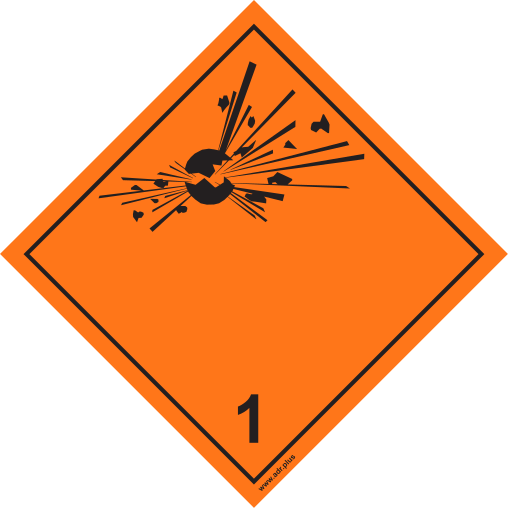 Class 1
UN 0168, PROJECTILES with bursting charge
Projectiles with bursting charge — artillery ammunition, 1.1D
LQ 0
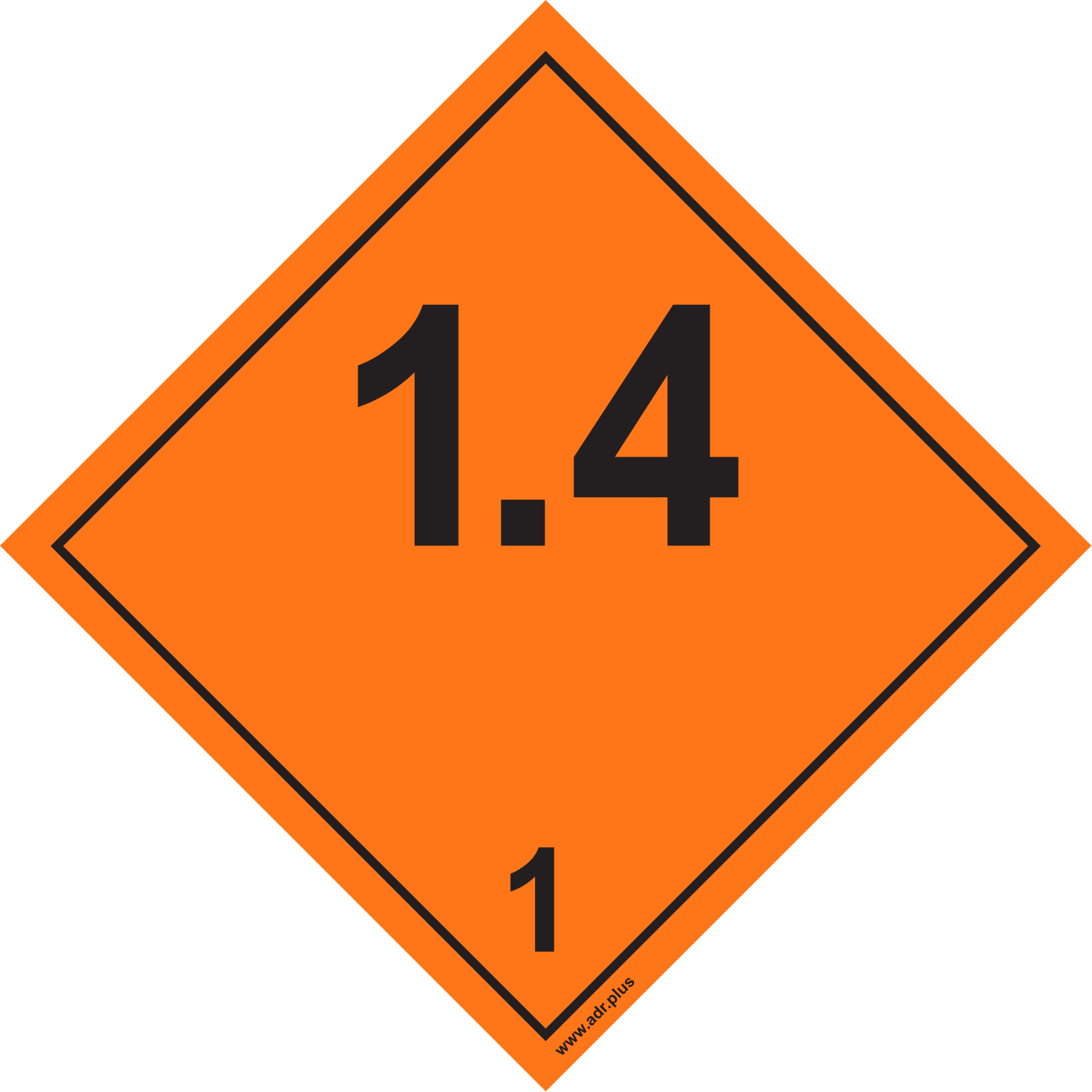 Class 1
UN 0012, CARTRIDGES FOR WEAPONS, INERT PROJECTILE or CARTRIDGES, SMALL ARMS
Cartridges for weapons, inert projectile, small arms — 1.4S
LQ 5 kg
Class 1UN 0241, EXPLOSIVE, BLASTING, TYPE E
Explosive, blasting, type E — emulsions for quarries, 1.1D
LQ 0
Class 1UN 0030, DETONATORS, ELECTRIC for blasting
Detonators, electric, for blasting — 1.1B
LQ 0
Class 1UN 0336, FIREWORKS
Fireworks — 1.4G pyrotechnics, the November-December season
LQ 0
Class 1UN 0190, SAMPLES, EXPLOSIVE, other than initiating explosive
Samples, explosive — testing and classification approval
LQ 0
Three ways your goods can travel
The same product can go as limited quantities, under the 1.1.3.6 partial exemption or in full ADR — the classification and the packaging decide.
Limited quantities (LQ)
Small inner packagings within the column 7a limit, up to 30 kg gross — the goods travel with the LQ diamond, free of most other ADR provisions (Chapter 3.4).
Partial exemption (1.1.3.6)
Below the transport category threshold per transport unit — no orange plates, no written instructions, no ADR driver certificate (the list in 1.1.3.6.2).
Full ADR
Above the thresholds the goods travel under the full set of rules — transport document, plates and labels, equipment, trained crew and every participant duty.
The same cartridges travel differently — 1.4S goes as transport category 4 without a mass limit, 1.4G fireworks up to 333 kg fit under 1.1.3.6, and 1.1D artillery shells travel in full ADR on an EX/II or EX/III transport unit with a security plan in any quantity.
Who answers for what
ADR splits the duties among the participants of the carriage. These are the roles your company typically holds — with the exact ADR paragraphs.
Consignor
Hands over only classified and authorized Class 1 articles in approved packagings, with the transport document and the competent authority classification approval where required.
Carrier
Checks the documents and the authorization of the goods, uses an EX/II or EX/III transport unit with a driver holding the Class 1 specialization, keeps within the mass limits of 7.5.5.2.1 and the mixed loading prohibitions.
Loader
Loads only authorized goods, observes the mixed loading prohibitions between compatibility groups and the stowage rules, allows no smoking or fire near the transport unit.
For each of these roles the company needs an appointed safety adviser (1.8.3.1) — ours works on subscription.
About the DGSAWhat a mistake costs
In Class 1 an inspection looks beyond the papers. A missing security plan, a transport unit loaded above 7.5.5.2.1 or a prohibited mixed load stops the journey on the spot — and for defence deliveries, breaks the contract.
Sanctions are national — checks are European
Every ADR country sets its own fines for dangerous goods violations. Roadside checks follow one European standard — Directive (EU) 2022/1999 with a common list of infringements by risk category. Open your country to see the authorities and the exact amounts.
Find your countryAnd beyond the fines
- A vehicle stopped at a roadside check — with your customer waiting for the delivery
- An incident with an untrained crew — and an insurer reading the file closely
- Violations on record — and inspections coming back more often
What the law expects from you
ADR duties come first — and your industry carries its own EU rules on top.
Under ADR
- Classify every product before it is handed over for carriage
- Train everyone who touches dangerous goods (Chapter 1.3)
- Appoint a safety adviser — carriers, consignors, loaders, packers alike
- Mark, document and equip every consignment correctly
EU rules of the industry
ADR 2025, Chapter 1.10
Table 1.10.3.1.2 — 0 kg threshold for packages of 1.1, 1.2, 1.3C, 1.5, 1.6 and fifteen 1.4 entries, the plan under 1.10.3.2.1 binds every participant
Law on civil explosives (LV)
Licences for production, trade and blasting are issued by the State Police, military explosives fall under the strategic goods law
Cabinet Regulation No 12 (LV)
Road carriage of explosives under ADR with mandatory armed escort
Law on pyrotechnic articles (LV)
Licences and categories of pyrotechnics, carriage rules set by the Cabinet
Directive 2014/28/EU
Harmonisation of civil explosives on the EU market, CE marking and traceability
The industry in numbers
€2.16 bn
Defence budget of one EU member state for 2026 — 4.91 % of GDP
Source · mod.gov.lv, 10.12.20250 kg
Security plan threshold for packages of divisions 1.1, 1.2, 1.3C, 1.5 and 1.6
Source · ADR 2025, 1.10.3.1.2Is this about you?
If even one line matches your operation — it is worth a conversation.
- A safety adviser qualified for Class 1 is appointed
- Each article's classification is approved by the competent authority (2.2.1.1.3)
- The security plan is adopted, implemented and known to the staff (1.10.3.2)
- EX/II or EX/III transport unit, mass limits per 7.5.5.2.1
- Mixed loading only of permitted compatibility groups (7.5.2.2)
- Driver with the Class 1 specialization, staff trained under 1.3 and 1.10.2
Our solutions
One system for the whole chain — from classification approval to the loader's briefing. We already run a complete document programme for an explosives manufacturer — for your site it is configured, not written from scratch.
Cargo instruction with the transport document entry
Classification, the carriage regime and the ready transport document entry — for a specific cargo.
from €50 / document
A consultant on subscription
A certified safety adviser, the appointment notice and the platform — from €50 a month plus €10 per consignment.
ADRplus One
Train the team
Chapter 1.3 courses online, in your languages — at your own pace, with certificates.
Course is being updated
ADR compliance audit
A remote compliance audit with a report — where you stand and what to fix first.
€290
Questions from the industry
Have a different question?
Contact the consultantDo we need a plan for just a few boxes?
For packages of 1.1, 1.2, 1.3C, 1.5 and 1.6 — yes, Table 1.10.3.1.2 sets a 0 kg threshold. The 1.10.4 exemption covers tanks and bulk only.
Do fireworks need a plan too?
UN 0336 (1.4G) and UN 0335 (1.3G) fireworks are not in Table 1.10.3.1.2 — no plan, but the adviser, 1.3 training, documents and the 1.1.3.6 limits remain.
We supply components to a plant — does this concern us?
If you dispatch, pack or load Class 1 articles you are a participant under 1.4 — the duties and the plan are yours, not the plant's.
Is carriage for the armed forces exempt from ADR?
Only vehicles belonging to or under the responsibility of the armed forces are exempt (Directive 2008/68/EC, Art. 1). A civilian carrier under contract is fully within ADR.
How long does implementation take?
The plan and instructions — two to three weeks after the questionnaire, implementation and training — another 30 days under our programme.
Tell us how your goods move
Within one working day you get a clear answer — what applies to you, what does not, and what it costs to be in order.