


“ADR licence”, “ADR certificate”, “ADR card” — in everyday use these all name the same document, which ADR itself calls the driver training certificate. Drivers of vehicles carrying dangerous goods must hold a certificate issued by the competent authority stating that they have participated in a training course and passed an examination on the particular requirements of carrying dangerous goods (ADR 8.2.1.1). There is no single European issuing office — each ADR contracting party examines drivers and issues its own cards, and a certificate issued in one country is accepted by all the others for as long as it is valid (ADR 8.2.1.6).
Who needs an ADR licence
The rule itself is short — drivers of vehicles carrying dangerous goods hold the certificate (ADR 8.2.1.1). What keeps much of the small-load traffic outside it are the exemptions.
- Loads within the 1.1.3.6 thresholds. When the quantity on the transport unit stays within the limit for its transport category, the carriage is exempt from almost all of Part 8, including driver certification (ADR 1.1.3.6.2).
- Limited quantities. Goods packed under Chapter 3.4 are not subject to the driver certification requirements either (ADR 3.4.1).
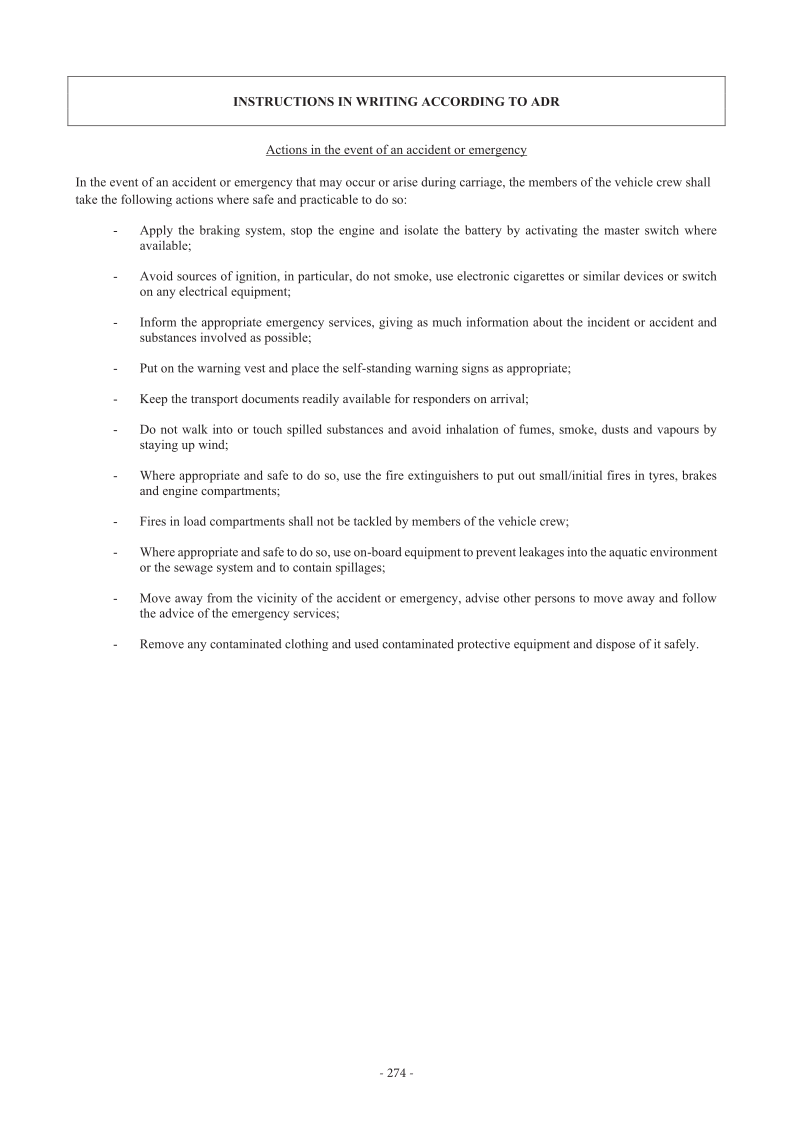
Neither exemption removes training altogether — everyone involved in the carriage of dangerous goods, including drivers without a certificate, must still be trained for their duties in accordance with Chapter 1.3 (ADR 8.2.3). And during carriage the licence travels with the vehicle — it is one of the documents that must be carried in the driver’s cab of the transport unit (ADR 8.1.2.2).
Basic course and specialisations
Every driver starts with the basic training course approved by the competent authority (ADR 8.2.1.2), and the certificate is issued once the examination is passed (ADR 8.2.2.8.1). Three specialisations extend it.
- Tanks — required for fixed or demountable tanks over 1 m³ capacity, for battery-vehicles with a total capacity over 1 m³, and for tank-containers, portable tanks or MEGCs with an individual capacity over 3 m³ on a transport unit — MEMU drivers fall under the same rule (ADR 8.2.1.3). The qualifiers matter — for battery-vehicles the 1 m³ threshold reads on total capacity, while for tank-containers, portable tanks and MEGCs it is 3 m³ per unit.
- Class 1 — explosives, except substances and articles of Division 1.4, compatibility group S (ADR 8.2.1.4).
- Class 7 — radioactive material (ADR 8.2.1.4).
Each specialisation is added to the certificate after its own examination (ADR 8.2.2.8.1). Restricted basic and restricted tank courses — limited to specific goods or classes — also exist, and the certificate then clearly states its limited scope (ADR 8.2.1.2, ADR 8.2.2.8.1). Extending the scope mid-term does not restart the clock — the new certificate keeps the expiry date of the previous one (ADR 8.2.2.8.2).
Five years of validity — and the 12-month renewal window
The certificate is valid for five years from the date the driver passes the initial basic or initial comprehensive examination (ADR 8.2.2.8.2). To renew it, the driver completes refresher training (ADR 8.2.2.5) and passes an examination — and the start of the new five years depends on the timing (ADR 8.2.2.8.2).
- Exam passed in the twelve months before expiry — the new certificate runs from the expiry date of the old one, so no validity is lost.
- Exam passed earlier than twelve months before expiry — the new certificate runs from the day the refresher exam was passed, and the remaining months are forfeited.
Both renewal routes exist only while the certificate is still valid (ADR 8.2.2.8.2). For an expired certificate ADR provides no renewal route — a new certificate is only issued the ordinary way, after the full initial course and examination (ADR 8.2.2.8.1). That is the expensive mistake — a refresher exam booked after the expiry date means weeks off dangerous goods work. The refresher itself is shorter than the initial course — at least half its duration, or at least two days for a comprehensive course (ADR 8.2.2.5.2).
What the card looks like
The licence is a plastic card in ISO 7810 ID-1 format — bank-card size — white with black lettering and a security feature such as a hologram, UV printing or guilloche patterns (ADR 8.2.2.8.3). The front carries the certificate number, the driver’s personal data, photograph and signature, the issuing body and the expiry date. The back lists the classes or UN numbers the driver may carry, in two columns — tanks and other than tanks (ADR 8.2.2.8.5). The card is issued in the language of the issuing country. If that is not English, French or German, the key titles are repeated in one of those languages (ADR 8.2.2.8.4), and the card is accepted in every contracting party without further formalities (ADR 8.2.1.6).
How much does an ADR licence cost
ADR itself sets no fees — the cost of the licence is decided by each country, and it has three parts — the mandatory course at an approved training establishment (the largest item, priced by the market), the examination fee, and the fee for issuing the card. The exact rates are published by the national competent authority.
The pattern is the same everywhere — the course is the main cost, the state fees are tens of euros, and a failed attempt means paying the exam fee again — which makes preparation the cheapest item in the budget.
Before the course — test yourself
The exam questions are drawn from a catalogue prepared by the competent authority, and candidates do not see them in advance (ADR 8.2.2.7.1.3) — so it pays to find weak topics early. The free ADR practice test works without registration and explains every answer. For a structured run through the driver’s practical layer — placarding and orange plates, equipment, the instructions in writing, tunnels, the 1.1.3.6 exemptions — there is the online Transport safety course. To be clear — ADRplus is not an accredited training centre and does not issue ADR licences. The statutory course and exam happen at an approved establishment and the competent authority, and ours helps you arrive at both prepared.
References — ADR 2025 8.2.1 (training requirement and specialisations), 8.2.2.5 (refresher training), 8.2.2.7 (examinations), 8.2.2.8 (certificate, validity, card model), 8.2.1.6 (mutual recognition), 1.1.3.6.2 and 3.4.1 (exemptions), 8.1.2.2 (documents on board).