





Every enterprise that consigns, carries, packs, loads, fills or unloads dangerous goods on the road must appoint one or more Dangerous Goods Safety Advisers (DGSA, 1.8.3.1). The DGSA is the organisation’s internal compliance anchor — answerable to the head of the enterprise, responsible for helping to prevent the risks to people, property and the environment.
Who may be exempted (1.8.3.2) — the competent authorities may provide that the requirement does not apply to enterprises staying below the quantity thresholds of 1.1.3.6, 1.7.1.4 and chapters 3.3/3.4/3.5, and to those whose main or side business is not dangerous goods transport but who occasionally handle domestic consignments posing little danger or pollution risk.
Core duties (1.8.3.3) — what the adviser monitors
- Classification of goods into hazard class and packing group
- Vehicle / equipment procurement and inspection procedures
- Staff training, including record keeping, and regulatory changes
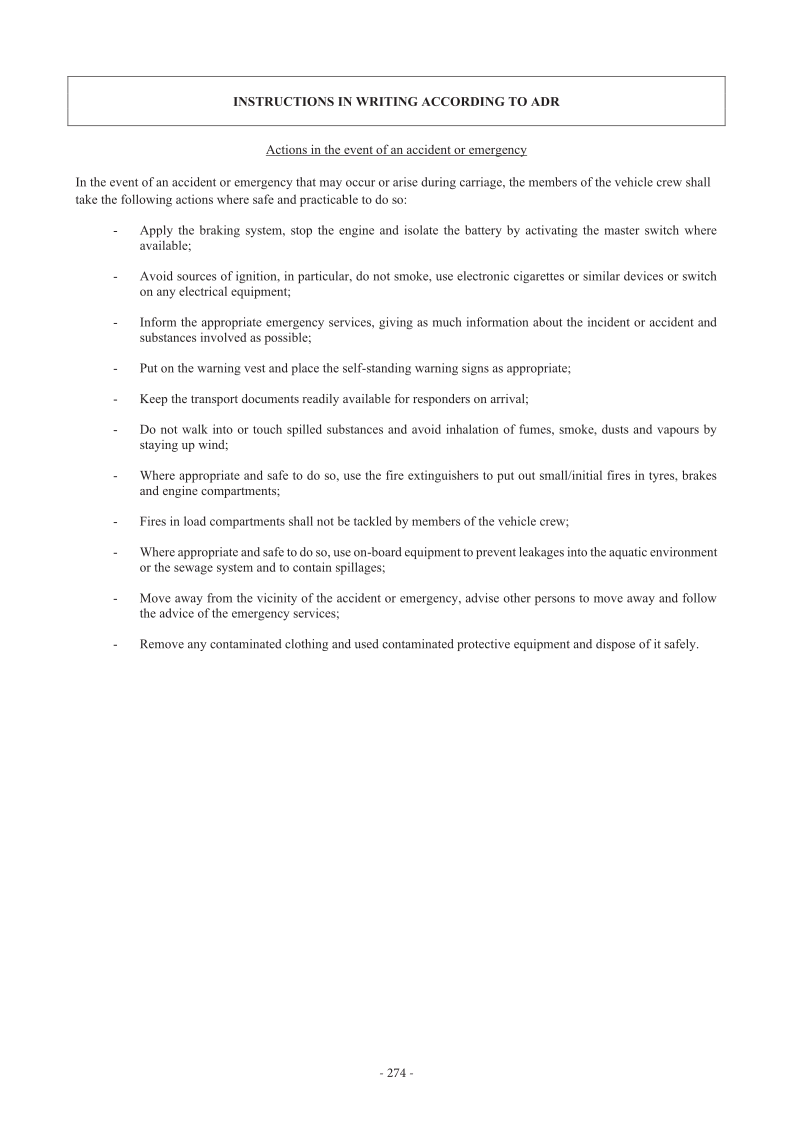
- Emergency response plan for accidents during transport, loading, unloading
- Incident investigation and preventive measures
- Subcontractor and third-party vetting
- Transport document presence + required safety equipment on vehicle
- Security plan under 1.10.3.2 (for high-consequence goods)
Annual report (1.8.3.3) — the DGSA prepares an annual report on the enterprise’s dangerous-goods activities for management or the local authority. Report must be kept five years and produced on request.
Incident report (1.8.3.6) — after any accident affecting people, property or environment during transport, packing, filling, loading or unloading, the DGSA drafts an incident report for management or the authority.
Certification (1.8.3.7–10) — the DGSA holds a vocational training certificate issued by the competent authority of an ADR contracting party, or by the body it designates. The certificate form states the mode it covers (road, rail, inland waterway) (1.8.3.18), and where a contracting party issues a certificate for one type of goods only, it says so (1.8.3.13). It is valid for five years, extended for five years at a time if the holder passes a renewal examination during the year before expiry (1.8.3.16.1).
Who can serve — an employee, the manager, or an external consultant (1.8.3.4), as long as they can perform the duties.
Common mistake — a logistics company below the 1.1.3.6 threshold still uses subcontractors that handle much larger loads. The exemption is judged on the enterprise’s own activity. If the enterprise organises the dangerous-goods transport (even via subcontractors), a DGSA is usually required.
References — ADR 2025 1.8.3.1 (appointment), 1.8.3.2 (exemptions), 1.8.3.3 (duties), 1.8.3.4 (who may serve), 1.8.3.6 (incident report), 1.8.3.7–10 (certificate and training), 1.8.3.13 (certificate limited to one type of goods), 1.8.3.16.1 (validity and renewal), 1.8.3.18 (form of certificate), 1.10.3.2 (security plan).