
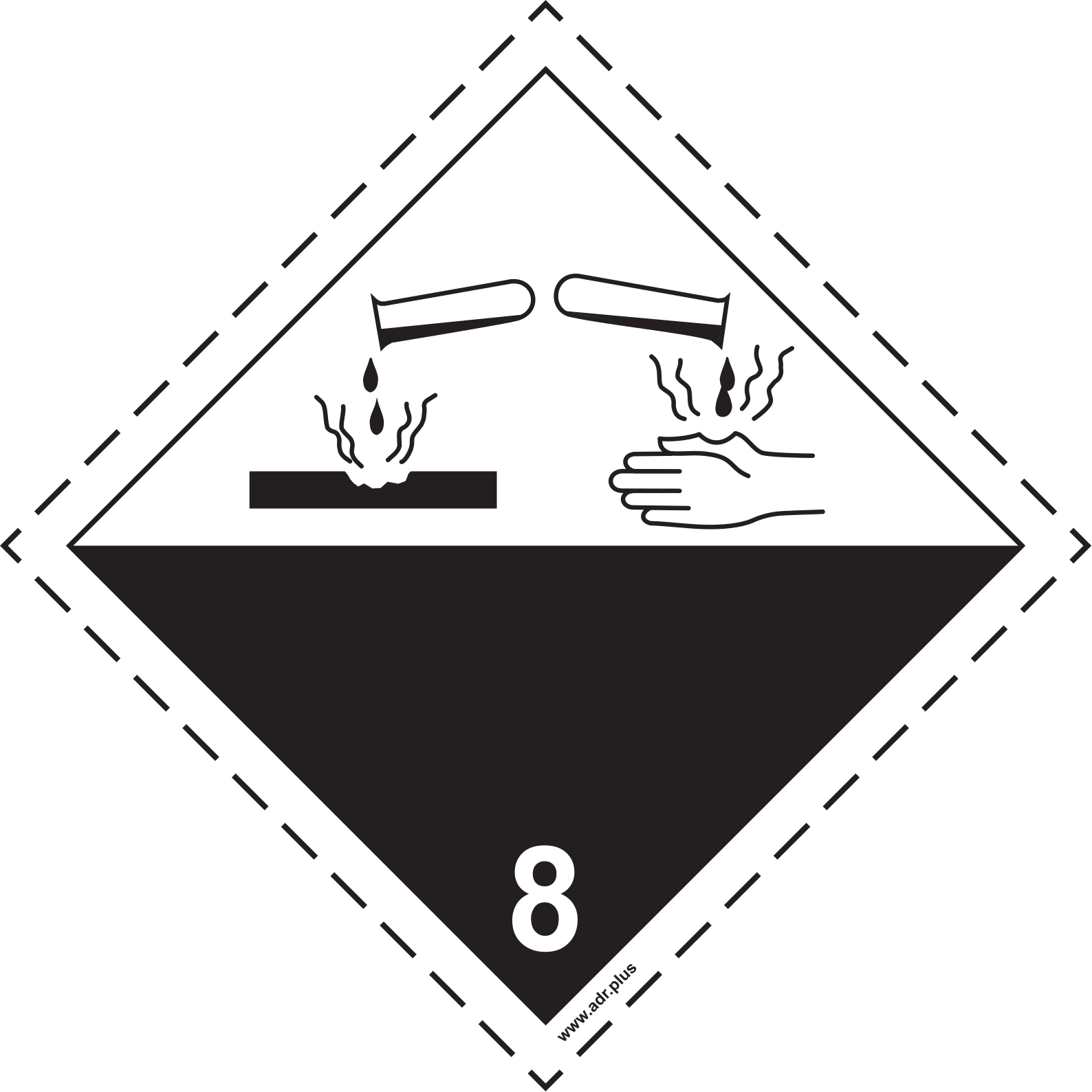
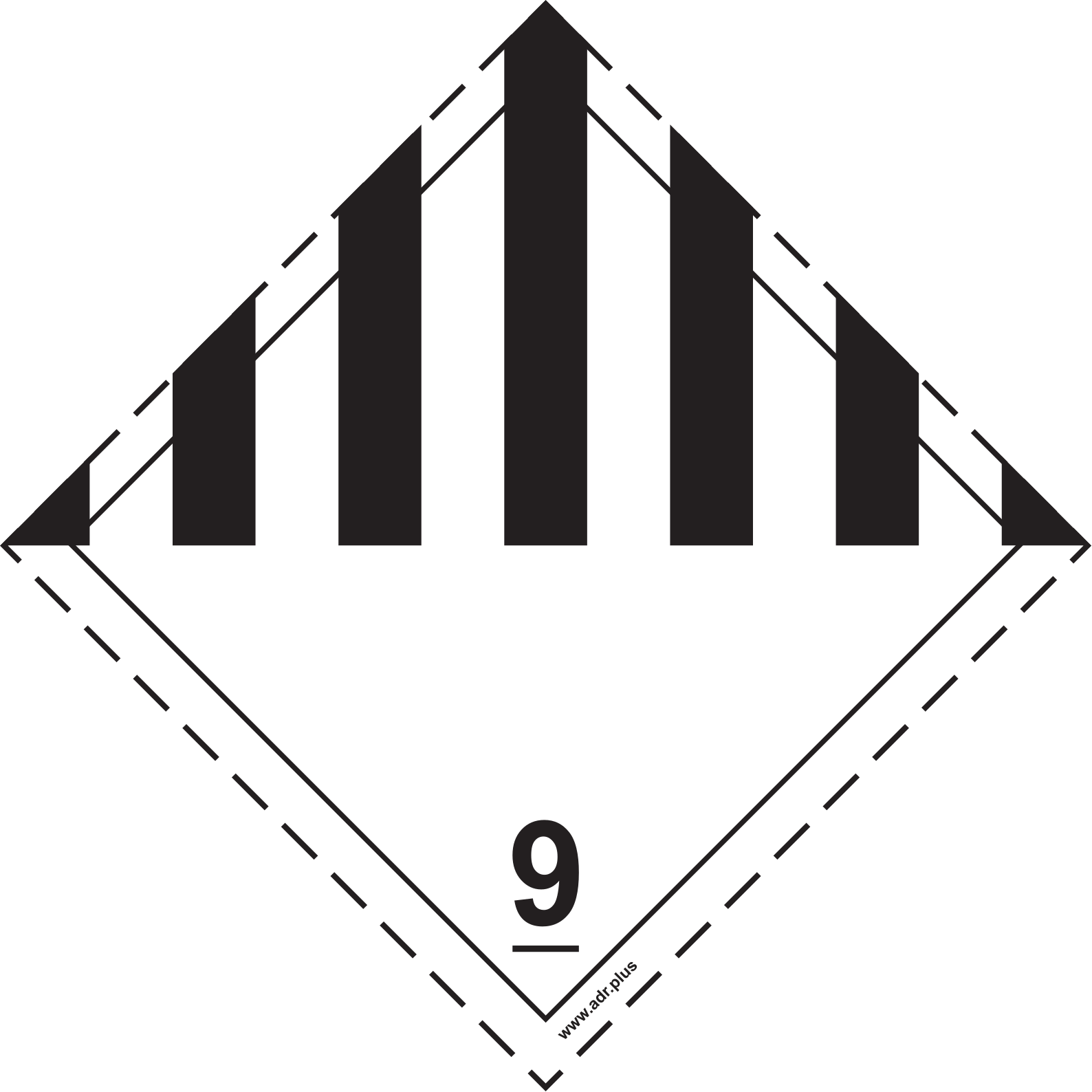

Excepted Quantities go further than limited quantities — if a substance travels in very small inner receptacles inside a robust outer box, ADR effectively does not apply — no hazard labels, no placards, no driver ADR certificate, no segregation. A short transport-document line and the EQ mark on the package are the only dangerous-goods traces left.
Per-substance limit — Column 7b of Table A, coded E0 to E5 (3.5.1.2).
E0— excepted quantities not permittedE1— inner 30 mL/g, outer 1000 mL/gE2— inner 30 mL/g, outer 500 mL/gE3— inner 30 mL/g, outer 300 mL/gE4— inner 1 mL/g, outer 500 mL/gE5— inner 1 mL/g, outer 300 mL/g
E0 is common for toxic gases and class 1 explosives — EQ relief simply does not apply. Whatever the E code, the number of EQ packages in any vehicle or container may not exceed 1000 (3.5.5).
Package construction (3.5.2).
- Inner packaging — closure held securely in place, then packed with cushioning material into an intermediate packaging. For liquids the intermediate or outer packaging holds enough absorbent material to absorb the entire contents of the inner packagings
- The intermediate packaging goes into a strong, rigid outer packaging of wood, fibreboard or equally strong material
- The complete package as prepared for carriage, with inner packagings filled to at least 95 % of their capacity for solids or 98 % for liquids, must pass a 1.8 m drop test and a 24-hour stacking test under a load equivalent to a 3 m stack of identical packages (3.5.3.1)
- No UN packaging code is required — the package is tested as a unit against 3.5.3

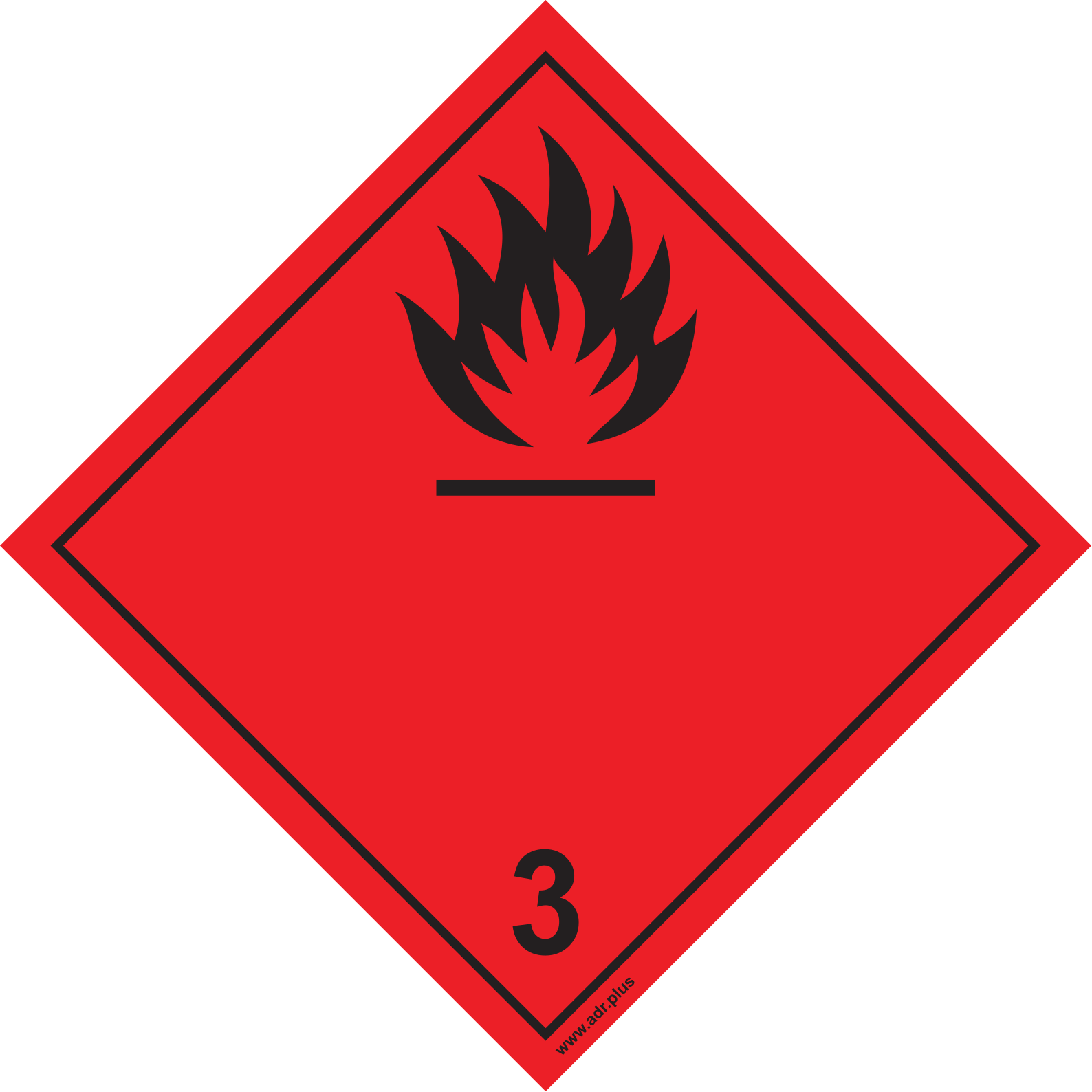
EQ mark (3.5.4). Square with side ≥ 100 mm, hatched border, hatching and symbol in the same colour, black or red, on white or a suitable contrasting background (3.5.4.2). The E symbol in its circle sits in the upper part of the mark. Below it goes the first or only label number from Column (5) of Table A for each of the goods in the package, and below that the consignor’s or consignee’s name if it is not shown elsewhere on the package (3.5.4.1, 3.5.4.2). For radioactive material, the excepted-package requirements of 1.7.1.5 apply instead (3.5.1.1 NOTE).
Transport document (3.5.6). When any document is carried, it states DANGEROUS GOODS IN EXCEPTED QUANTITIES and the number of packages. No UN number. No class. No packing group. ADR itself does not require any transport document for EQ consignments — 3.5.6 applies only when a document accompanies the goods anyway. Some competent authorities still ask for a shipper’s declaration, so check the national rule.
No driver ADR certificate. No vehicle placards. No 7.5.2 segregation — excepted quantities sit outside the mixed-load constraints.
And no 1.1.3.6 points. Goods in excepted quantities are not counted into the 1000-point calculation of the 1.1.3.6 small-load exemption either — 1.1.3.6.5 leaves out of account the goods exempted under 1.1.3.2 to 1.1.3.5, and the EQ relief is exactly the exemption of 1.1.3.4.3. 3.5.1.1 leaves only the training of Chapter 1.3, the classification and packing group criteria of Part 2 and the packaging requirements of 4.1.1.1, 4.1.1.2, 4.1.1.4 and 4.1.1.6 applicable.
Common mistake — confusing EQ with LQ. LQ has higher per-inner limits (up to 5 L) and still uses the 3.4 mark and the transport-unit marking thresholds of 3.4.13-3.4.14. EQ is much tighter (mL/g per inner, tested as a unit) and carries near-zero regulatory overhead. Columns 7a and 7b are not interchangeable — read them separately.
References — ADR 2025 3.5.1 (limits and E codes), 3.5.2 (package construction), 3.5.3 (tests), 3.5.4 (mark), 3.5.6 (transport document), Table A Column 7b.