
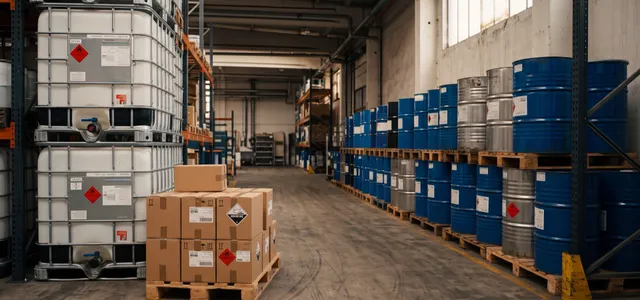






Packing group ranks severity within a class.
- PG I — substances presenting great danger
- PG II — substances presenting medium danger
- PG III — substances presenting minor danger
The packing group decides which UN packagings and IBCs can legally hold the substance and what additional controls apply. A PG I substance must travel in X-coded packaging. Y-coded packaging covers PG II and below, and Z-coded covers PG III only. The letter records the packing group(s) for which the design type was successfully tested (6.1.3.1 (c)) — the tests themselves are in 6.1.5.
Which classes use packing groups. Classes 3, 4.1, 4.2, 4.3, 5.1, 6.1, 8 and 9 use them, except that self-reactive substances of Class 4.1 stay outside the scheme. Classes 1, 2, 5.2, 6.2 and 7 do not use them — their hazard is ranked by other properties (compatibility group for 1, classification code for 2, type for 5.2, category for 6.2, package type and activity limits for 7). Articles are not assigned to packing groups at all (2.1.1.3).
How the group is assigned. Each class sets its own criteria in 2.2.
- Flammable liquids (2.2.3.1.3) — flash point and initial boiling point. PG I — IBP ≤ 35 °C. PG II — FP < 23 °C and IBP > 35 °C. PG III — 23 °C ≤ FP ≤ 60 °C and IBP > 35 °C.
- Toxic substances (2.2.61.1.7) — LD50 oral/dermal and LC50 inhalation thresholds.
- Corrosives (2.2.8.1.5.3) — exposure time and observation period within which irreversible damage of intact skin tissue occurs. PG III also covers substances with a corrosion rate on steel or aluminium above 6.25 mm a year at 55 °C.
- Oxidizers (2.2.51.1.8 for solids, 2.2.51.1.10 for liquids) — burning time or burning rate against potassium bromate or calcium peroxide reference mixtures for solids, pressure rise time against reference mixtures for liquids.
On the transport document the packing group follows the class number as II or PG II — either form is accepted under 5.4.1.1.1 d.
Common mistake — loading a PG I substance into a Y-coded drum “because it looks the same as our usual stock.” The drop-test performance behind X and Y ratings is not cosmetic. Wrong packaging rating puts the whole consignment out of compliance — and roadside inspectors read the packaging code.
References — ADR 2025 2.1.1.3 (definition), 2.2.3.1.3, 2.2.8.1.5.3, 2.2.51.1.8, 2.2.61.1.7 (class-specific criteria), 6.1.3.1 (c) (X/Y/Z letter), 6.1.5 (packaging performance tests).