
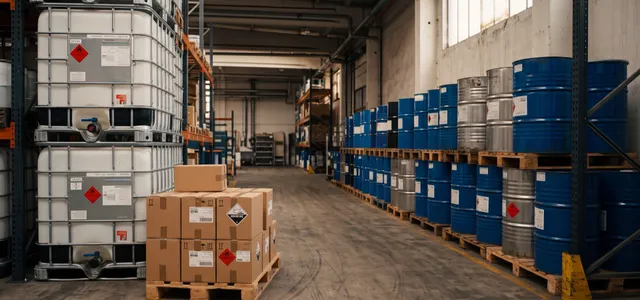
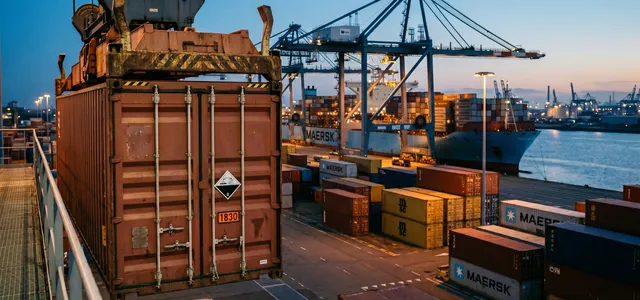




An Intermediate Bulk Container sits between a package and a tank — a rigid or flexible container with a capacity of up to 3 m³ (3000 L) designed for mechanical handling by forklift or pallet jack. IBCs are regulated under 6.5 (construction and testing) and 4.1.2 (selection and use).
Types (6.5.1.4).
- 11A / 11B — metal IBC for solids (steel / aluminium)
- 11H1 / 11H2 — rigid plastic IBC for solids
- 13H1 / 13H2 / 13H3 / 13H4 / 13H5 — flexible IBC (big bag) for solids
- 31A / 31B — metal IBC for liquids
- 31H1 / 31H2 — rigid plastics IBC for liquids (31H1 fitted with structural equipment, 31H2 freestanding)
- 31HZ1 / 31HZ2 — composite IBC with a plastics inner receptacle for liquids — the familiar 1000 L IBC tote. In the marking the letter
Zis replaced by the letter of the outer casing material, so a plastics receptacle in a steel cage is31HA1(6.5.1.4.3) - 31N — metal IBC for liquids, other than steel or aluminium

Code structure (6.5.2.1.1). A full IBC marking looks like 31HA1/Y/0323/NL/ABC/10800/1200 — type, packing group coverage, month and year of manufacture, State that authorized the mark, manufacturer, stacking test load in kg (0 for IBCs not designed for stacking), maximum permissible gross mass in kg. Capacity, tare mass, test pressure and the dates of the last inspection and leakproofness test are additional marks under 6.5.2.2.1, usually on the plate.
Periodic inspection (6.5.4.4). Every metal, rigid plastics and composite IBC — whatever it carries — is inspected at intervals of not more than 5 years (conformity to the design type including marks, internal and external condition, service equipment) and of not more than 2.5 years (external condition and service equipment). IBCs for liquids, and for solids filled or discharged under pressure, additionally undergo a leakproofness test before first use and at intervals of not more than 2.5 years (6.5.4.4.2). Flexible IBCs fall outside this regime — 6.5.4.4 does not cover them, and they carry solids only.
Filling and use (4.1.2).
- Sufficient ullage must be left in an IBC so that at a mean bulk temperature of 50 °C it is not filled to more than 98 % of its water capacity (4.1.1.4)
- An IBC marked with a hydraulic test pressure may be filled only with a liquid whose vapour pressure stays within the limits of 4.1.1.10. IBCs intended for liquids may not carry liquids with a vapour pressure above 110 kPa at 50 °C or 130 kPa at 55 °C
- An IBC showing signs of reduced strength compared with the tested design type may no longer be used unless it is repaired or routinely maintained so that it can withstand the design type tests (4.1.1.9), and it must be inspected and tested again before re-use (4.1.2.2)
Common mistake — using a composite IBC past its 5-year retest date. The test plate on the cage shows the last retest. Beyond the due date the IBC may no longer be filled or offered for carriage — an IBC filled before expiry may still travel for at most three months (4.1.2.2). Roadside inspectors read the plate, and the consignment is stopped.
References — ADR 2025 6.5.1.4 (type codes), 6.5.2.1.1 (marking format), 6.5.2.2.1 (additional marks), 6.5.4.4 (periodic inspection), 4.1.2.2 (inspection intervals in use), 4.1.1.4 (degree of filling), 4.1.1.10 (vapour pressure limits).