
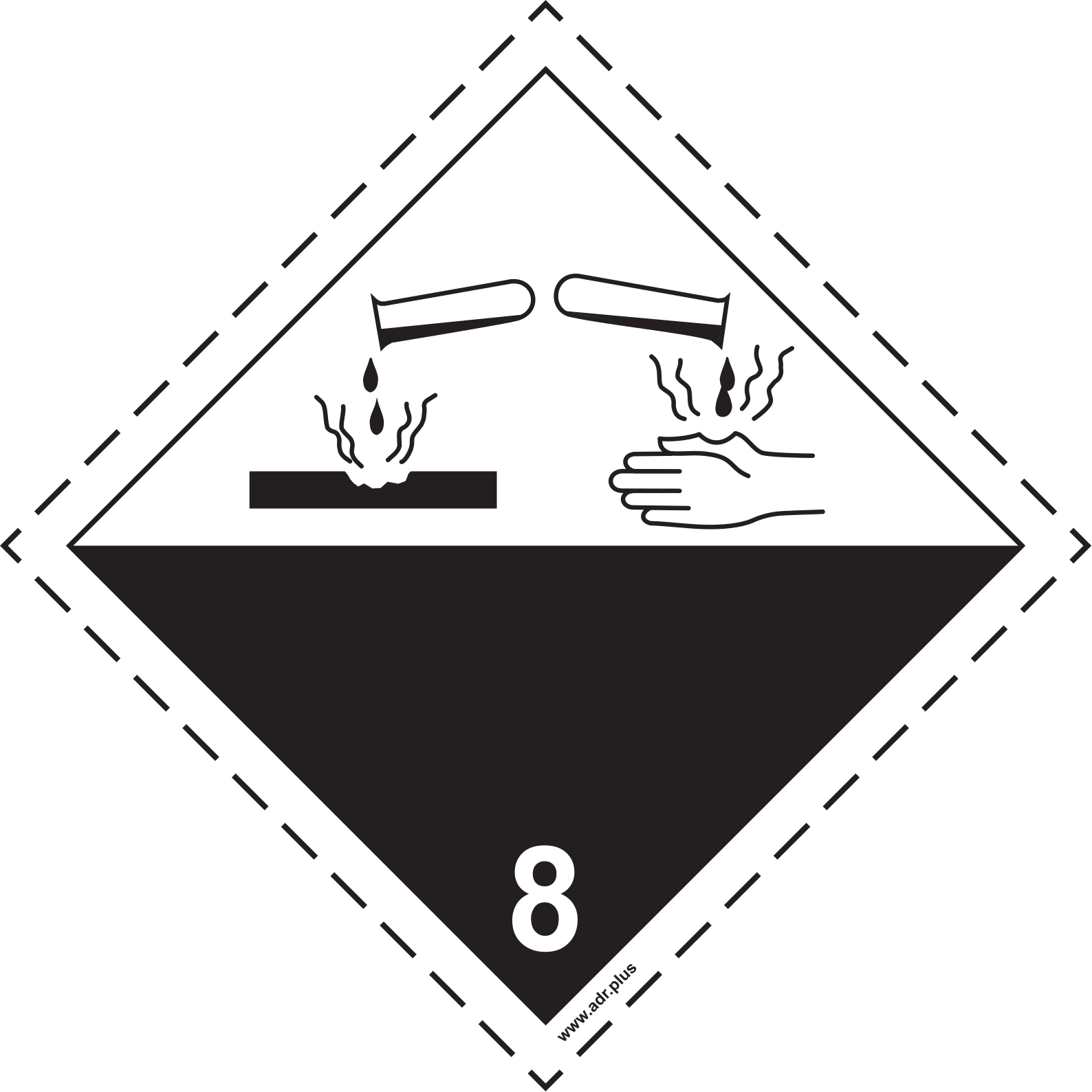


Every ADR tank carries a four-character code that tells you, at a glance, what it is certified to carry. You’ll find the code required by a substance in Column 12 of Table A. The code of the actual tank is stamped on the tank plate and printed in the tank certificate.
The four positions.
- 1) Type.
L— liquid.S— solid (granular or powder). Gas tanks (class 2) have their own code lettersC,P,R(4.3.3.1.1). - 2) Calculation pressure.
G— minimum calculation pressure per the general requirements of 6.8.2.1.14 — or the minimum calculation pressure in bar —1.5,2.65,4,10,15or21. - 3) Openings.
A— bottom-filling or bottom-discharge openings with two closures.B— bottom openings with three closures.C— top filling and discharge, only cleaning openings below liquid level.D— top filling and discharge, no openings below liquid level. - 4) Safety devices.
V— breather device without flame-propagation protection, or tank not resistant to the explosion pressure shock.F— breather device with flame-propagation protection, or explosion-pressure-shock-resistant tank.N— no breather device, not hermetically closed.H— hermetically closed tank.
Example — L4BH — liquid tank, calculation pressure 4 bar, bottom openings with three closures, hermetically closed.
Hierarchy (4.3.4.1.2). A tank with a different code may be used, provided every element of parts 1–4 offers a level of safety at least equivalent to the code in Table A, in the increasing order S → L, G → 1.5 → 2.65 → 4 → 10 → 15 → 21 bar, A → B → C → D, V → F → N → H. ADR’s own examples — an L10CN tank is authorized for a substance assigned L4BN, and an L4BN tank for a substance assigned SGAN. It does not work the other way — L4BN cannot lawfully be used for a substance that requires L10CN.
Common mistake — the carrier confirms the UN number matches the tank plate and forgets to compare tank codes. A substance requiring L4BH travelling in an L4BN tank is non-conformant — the second tank has no hermetic closure, and toxic vapour may vent to atmosphere during transport.
References — ADR 2025 4.3.4.1.1 (code construction), 6.8.2.1.14 (calculation pressure), 4.3.4.1.2 (hierarchy of use), Table A Column 12 (required tank code per substance).