



Not every dangerous goods movement needs the full weight of ADR behind it. The agreement itself carves out several exemptions for small quantities — and the best known of them, section 1.1.3.6, is also the one most often applied incorrectly, usually because it gets confused with the other two small-quantity regimes — limited quantities and excepted quantities. They solve related problems but work in genuinely different ways.
What 1.1.3.6 actually exempts
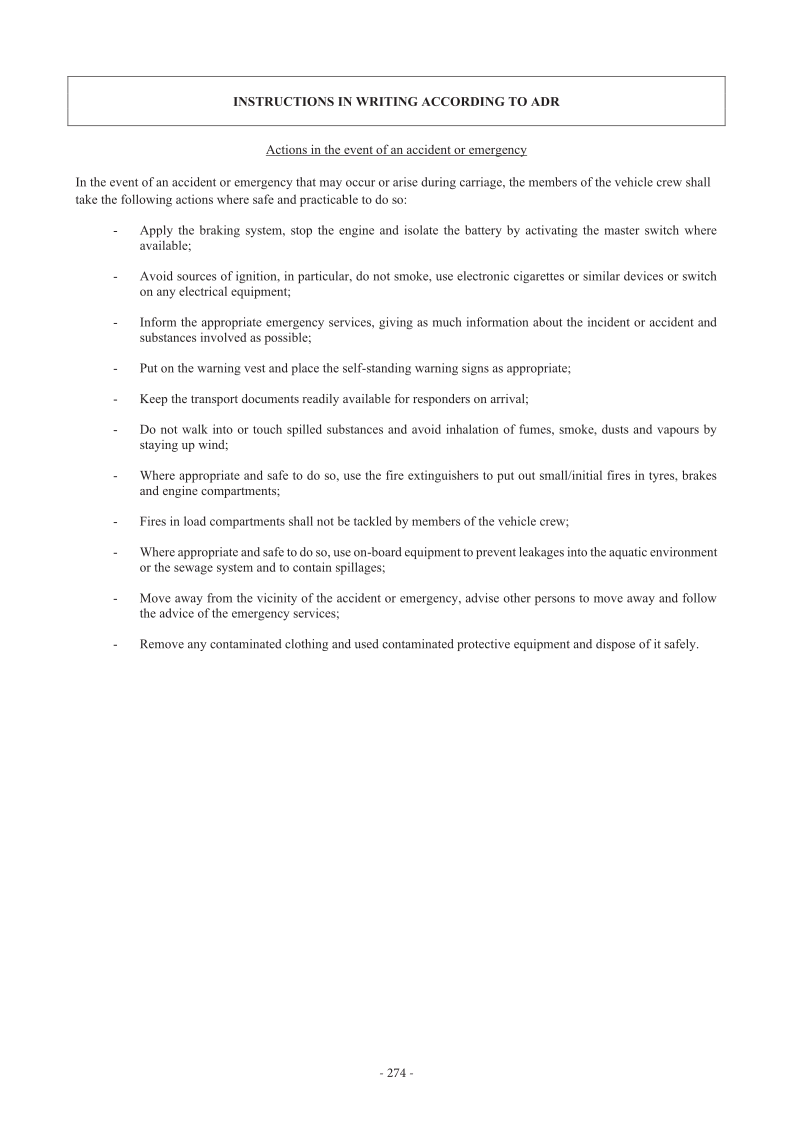
Section 1.1.3.6 exempts a vehicle from most of ADR’s heavier requirements — the written instructions, the ADR driver certificate, the specially equipped vehicle, the orange plates — provided the total quantity carried, once converted to “points” by transport category, stays under a fixed ceiling. It does not exempt the goods from classification, packaging or labelling requirements. Those still apply in full. The transport document stays mandatory too — 8.1.2.1 (a) keeps it on board, with the totals and the calculated value per transport category required by the transport document rules (5.4.1.1.1 (f), Note 1). What changes is everything around the vehicle and the driver, not the package itself.
This matters because 1.1.3.6 is frequently the difference between a van run that needs a certified ADR driver and specially fitted vehicle, and one that a normal delivery driver can make with an ordinary vehicle — as long as the quantity carried stays inside the limit. Two requirements survive even then — the driver still needs the awareness training of 8.2.3, and the vehicle still carries a 2 kg fire extinguisher (8.1.4).
How the point system works
Every dangerous substance carried under ADR is assigned a transport category, from 0 to 4, based on how dangerous it is. Transport category isn’t the same thing as packing group, though the two are related — category reflects an overall risk ranking used specifically for exemption calculations. Each category carries a different “multiplier” when converting litres or kilograms into points.
| Transport category | Multiplier | Practical effect |
|---|---|---|
| 0 | No exemption available | Always fully regulated, regardless of quantity |
| 1 | × 50 ¹ | Small quantities consume points fast |
| 2 | × 3 | Moderate quantities allowed |
| 3 | × 1 | Quantity carried counts directly as points |
| 4 | Unlimited | Effectively no point limit under this rule |
¹ For a handful of entries listed in note a to the 1.1.3.6.3 table (UN 0081, 0082, 0084, 0241, 0331, 0332, 0482, 1005 and 1017) the multiplier is 20 instead of 50, and the total quantity per transport unit may not exceed 50 kg.
To work out the total, you multiply the quantity of each substance (net kilograms for solids and liquefied gases, litres for liquids, receptacle water capacity in litres for compressed gases — 1.1.3.6.3 sets the unit for each group) by its category multiplier, then add the results across every dangerous substance on the vehicle. If the running total stays at or below 1000 points, the load qualifies for the 1.1.3.6 exemption. Cross that ceiling, even by one substance carried alongside several others, and the full ADR regime applies to the whole vehicle — not just the substance that pushed the total over.
A worked example
Picture a small delivery vehicle carrying two products in the same run — 40 litres of a Category 2 flammable liquid, and 15 kilograms of a Category 3 corrosive solid.
- Flammable liquid — 40 litres × 3 = 120 points
- Corrosive solid — 15 kilograms × 1 = 15 points
- Total — 135 points, comfortably under 1000, so the exemption applies to this load.
Now increase the flammable liquid to 300 litres instead of 40 — 300 × 3 = 900 points, plus the 15 from the solid, brings the total to 915 — still under the ceiling, but with very little headroom left for anything else added to that run. Add one more package of a Category 1 substance, even a small one, and the multiplier of 50 could tip the whole load over 1000 points on its own.
Transport categories and multipliers shown here follow the standard ADR structure, but the category assigned to any specific substance depends on its exact classification entry. Always confirm the transport category for the substance you’re moving — for instance through a UN number lookup — before relying on a 1.1.3.6 calculation for a real shipment.
How 1.1.3.6 differs from limited and excepted quantities
It’s easy to conflate 1.1.3.6 with the other two small-quantity regimes, but they operate on different logic.
- Limited quantities (LQ) require combination packaging — inner packagings placed in a suitable outer packaging, with a per-inner-packaging limit fixed by the substance’s specific ADR entry and a package gross mass of no more than 30 kg — plus the LQ diamond mark. In exchange, LQ carriage switches off most of the rest of ADR — no driver certificate, no orange plates, no specially equipped vehicle.
- Excepted quantities (EQ) apply to very small inner packagings (grams or millilitres), identified by an “E-code” on the UN number entry, and remove almost all ADR requirements for that specific package.
- 1.1.3.6 is calculated across the whole vehicle load by transport category points, and mainly relaxes driver, vehicle and placarding requirements — the transport document stays — rather than packaging.
A single shipment can, in principle, benefit from more than one of these at once — for example, part of the load packed as limited quantities, which under 3.4.1 already sits outside most of ADR in its own right, while the rest qualifies under 1.1.3.6 on points. What 1.1.3.6 itself takes out of the calculation is listed exhaustively in 1.1.3.6.5 — goods exempted under 1.1.3.1 (a) and (d) to (f), 1.1.3.2 to 1.1.3.5, 1.1.3.7, 1.1.3.9 and 1.1.3.10. Goods packed in limited quantities are not counted into the 1.1.3.6 points total. ADR does not say so in one sentence — Chapter 3.4 is absent from the list in 1.1.3.6.5, while 3.4.1 (a) keeps Chapter 1.1 applicable — so the position rests on how the regimes relate — 1.1.3.6 relieves by quantity the goods that would otherwise travel under the full ADR regime, and limited quantities are already outside most of it by their own mechanism. Getting the combination right takes a careful read of each substance’s specific ADR entry rather than a single rule of thumb.
Working it out for a real load
Manually adding up transport categories across a mixed load gets error-prone fast, especially with several substances and unit conversions between litres and kilograms. A 1.1.3.6 calculator that takes the substances and quantities on a specific run and returns the point total directly is the fastest way to get a reliable answer — and it’s worth re-running the calculation whenever the mix of goods on a route changes, not just once when the route is first planned.