


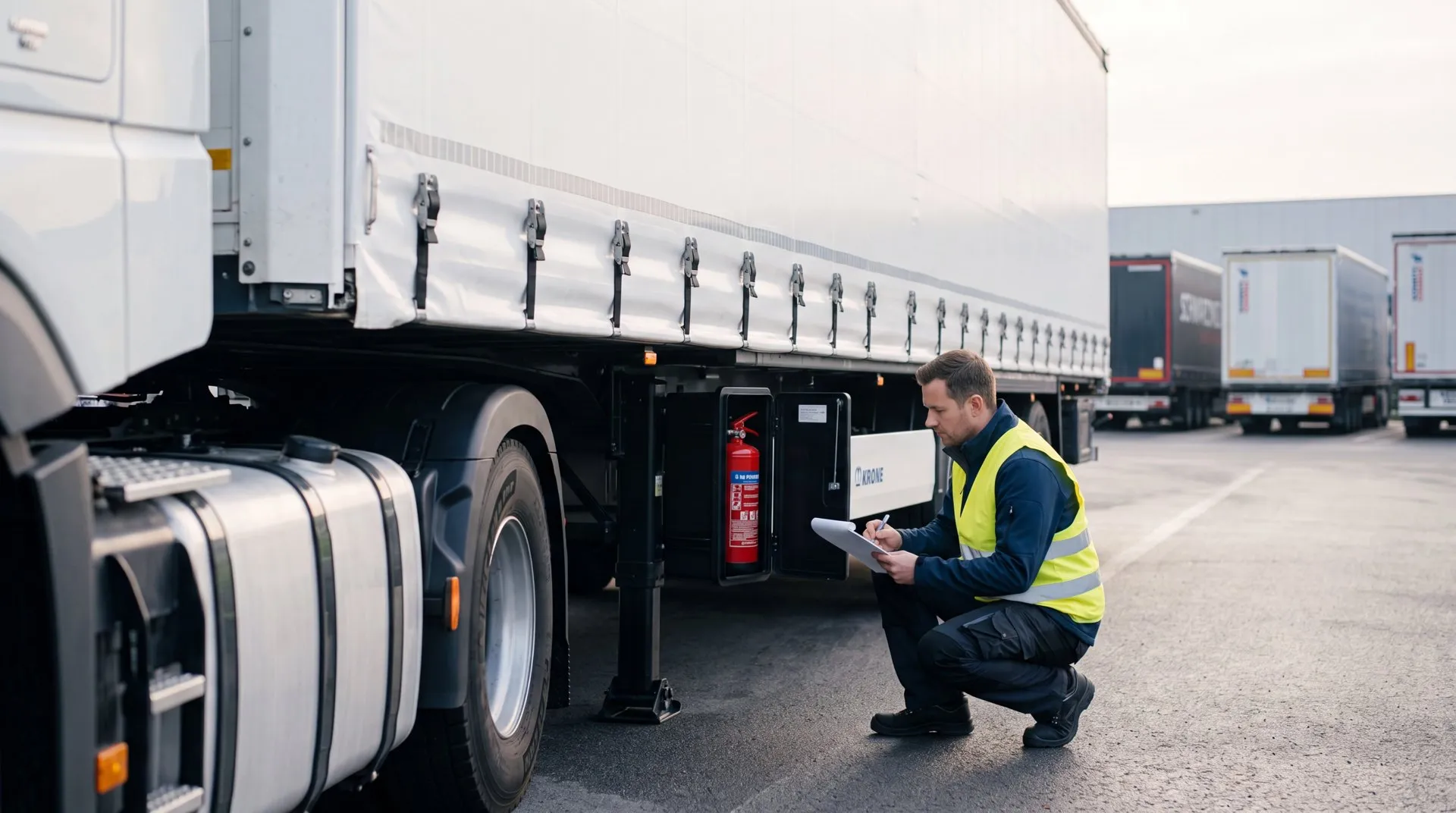
A haulier taking a first order for a pallet of paint or batteries usually asks two questions — “what do I need to buy” and “does the vehicle need re-registering”. The answer to the second is almost always “no”, to the first — a specific list from Part 8 of ADR. Here are both.
Does the vehicle need an ADR approval
Chapter 9.1 requires a certificate of approval and an annual technical inspection for five vehicle types only.
- EX/II and EX/III — for explosive substances and articles of Class 1.
- FL — for liquids with a flash-point of not more than 60 °C and for flammable gases in tanks with a capacity over 1 m³, or in tank-containers and portable tanks with an individual capacity over 3 m³.
- AT — for other dangerous goods in the same kind of tanks, where the vehicle is not an EX/III or FL vehicle or a MEMU.
- MEMU — mobile explosives manufacturing units.
A curtainsider, a box van or a flatbed carrying packages of Classes 2 to 9 is not on that list. It needs neither a certificate of approval nor a separate ADR inspection — the note to 9.1.2 says plainly that no special certificate is required for other vehicles beyond what the general safety regulations of the country of origin already ask for. This is a common misconception among hauliers, and it costs them orders they could perfectly well carry.
The exception is Class 1. Packages to which special provision V2 is assigned may be loaded only on EX/II or EX/III vehicles, and the choice between the two follows the quantity limits of 7.5.5.2.
What must be in the cab
Paragraph 8.1.2.1 names the documents that must always be in the driver’s cab.
- The transport documents under section 5.4.1 covering all the dangerous goods carried.
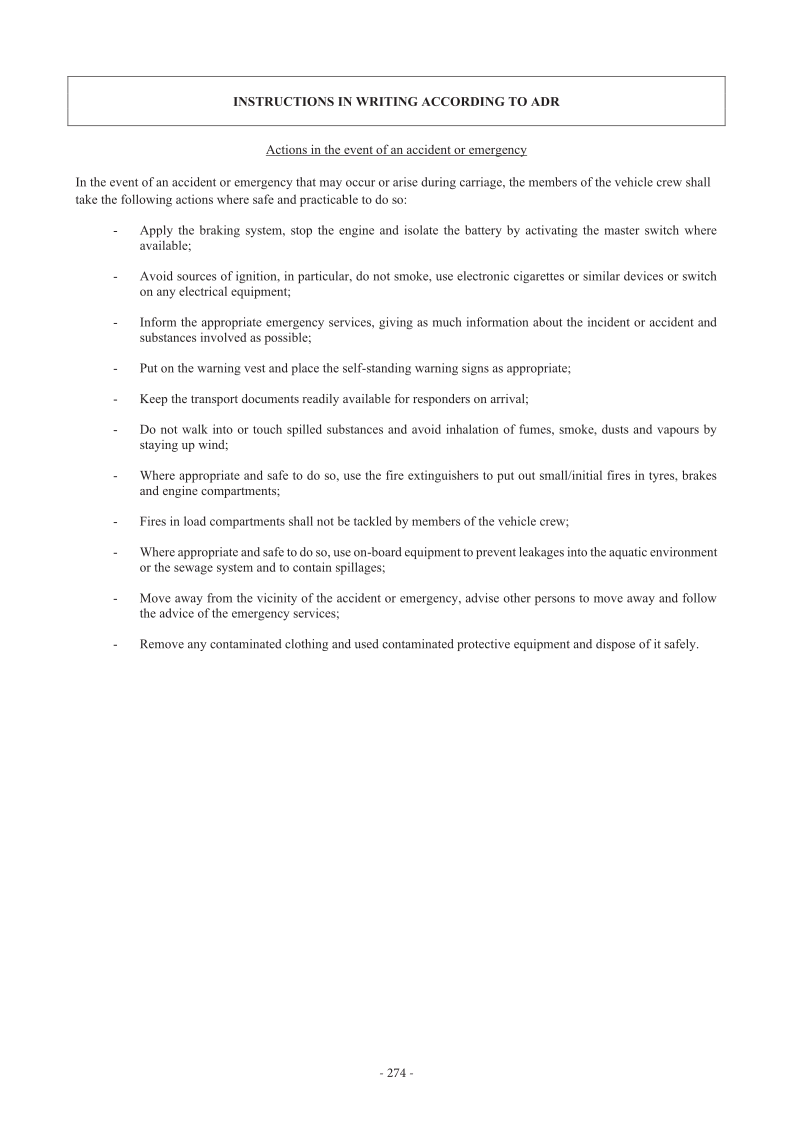
- The instructions in writing under section 5.4.3 — the four-page model, in a language each member of the crew can read and understand. Under 5.4.3.2 the carrier hands them to the crew, not the consignor.
- A means of identification with a photograph for each member of the crew.
Paragraph 8.1.2.2 adds the documents that ADR requires to be drawn up — the certificate of approval under 9.1.3, the driver training certificate under 8.2.1, and a copy of the competent authority approval where 5.4.1.2.1 (c) or (d) or 5.4.1.2.3.3 calls for one.
The driver training certificate is needed for any carriage above the exemptions. The basic course covers packages, while tanks and Classes 1 and 7, other than Division 1.4 compatibility group S, call for specialization courses.
Fire extinguishers
Table 8.1.4.1 sets the minimum by the maximum permissible mass of the transport unit.
| Mass of the transport unit | Number of extinguishers | Total capacity | For an engine or cab fire, at least | Additional extinguisher, at least |
|---|---|---|---|---|
| up to 3.5 tonnes | 2 | 4 kg | 2 kg | 2 kg |
| above 3.5 and up to 7.5 tonnes | 2 | 8 kg | 2 kg | 6 kg |
| above 7.5 tonnes | 2 | 12 kg | 2 kg | 6 kg |
Capacities are for dry powder, and any other suitable extinguishing agent must match them. Under 8.1.4.4 extinguishers carry a seal and a mark showing the date of the next inspection or of the maximum permissible period of use — once that date has passed, the requirement is no longer met. A transport unit carrying under the 1.1.3.6 exemption needs one 2 kg extinguisher, and the same exemption drops the plates of chapter 5.3, the instructions in writing of 5.4.3, the equipment of 8.1.5 and the driver training certificate.
Equipment
Paragraph 8.1.5.2 lists what is mandatory on every transport unit.
- A wheel chock for each vehicle, of a size suited to its maximum mass and to the diameter of the wheel.
- Two self-standing warning signs.
- Eye rinsing liquid — not required for danger label numbers 1, 1.4, 1.5, 1.6, 2.1, 2.2 and 2.3.
And for each member of the crew.
- A warning vest.
- Portable lighting apparatus conforming to 8.3.4, with no metal surface liable to produce sparks.
- A pair of protective gloves.
- Eye protection.
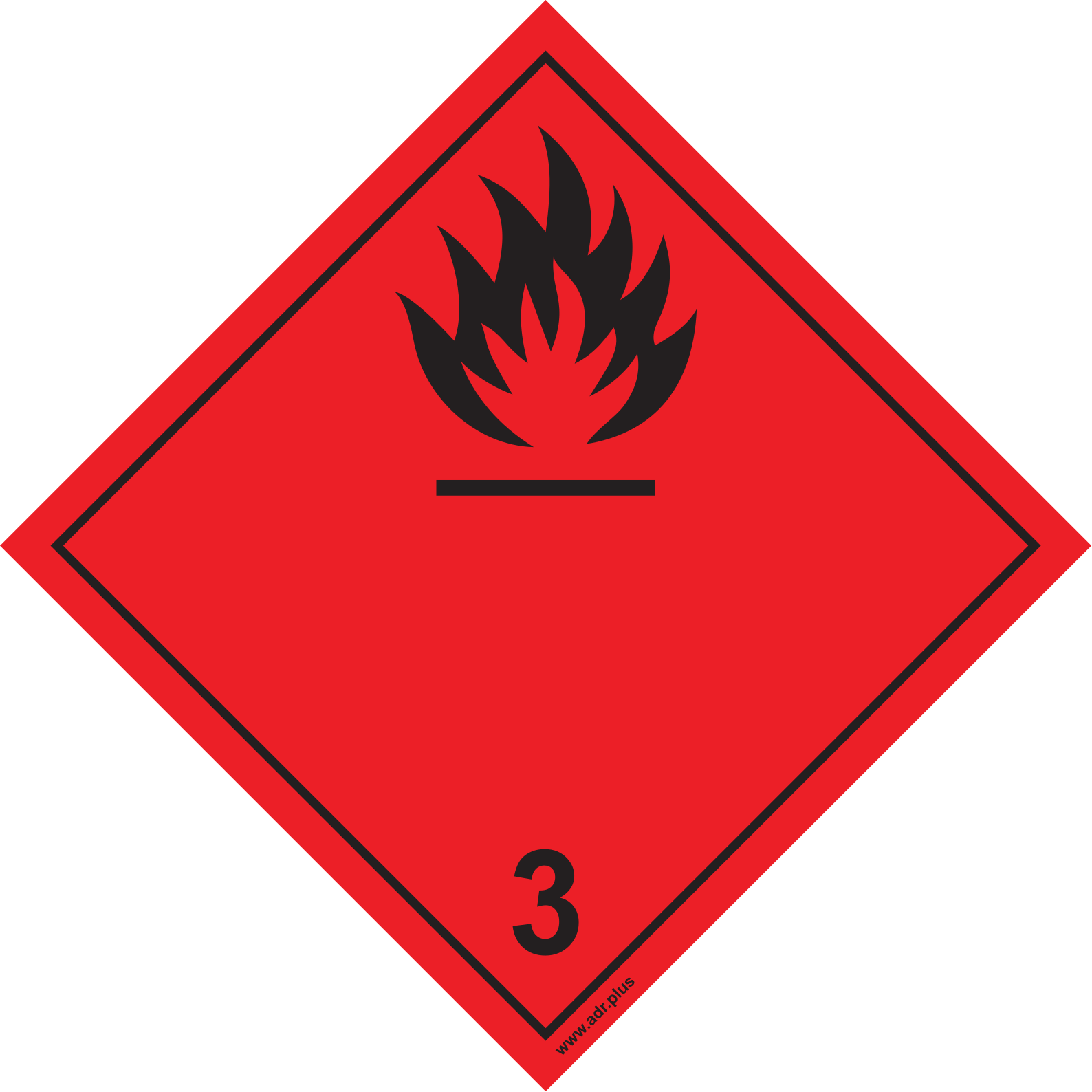
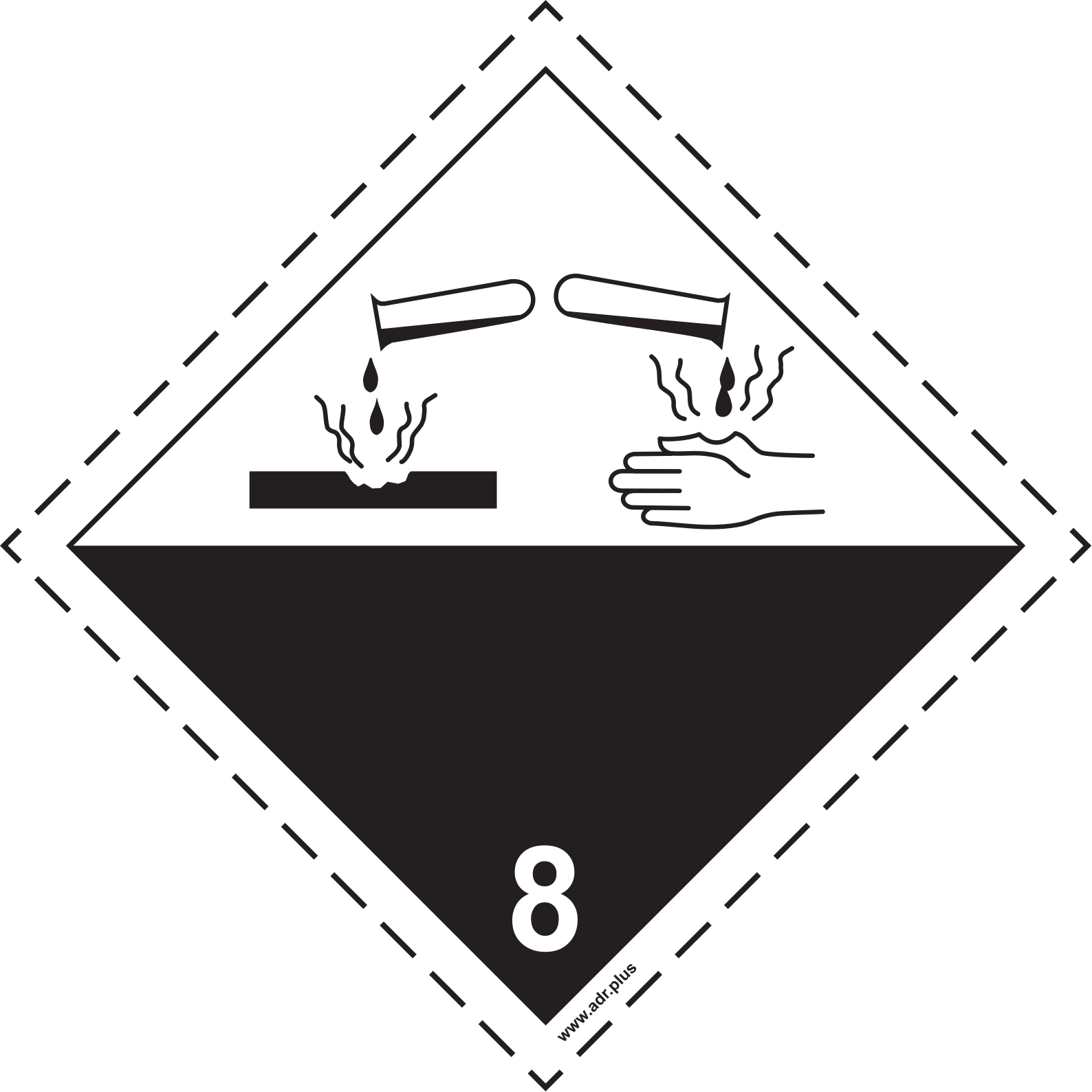
Paragraph 8.1.5.3 adds equipment by class — an emergency escape mask for each member of the crew where the danger label number is 2.3 or 6.1, plus a shovel, a drain seal and a collecting container for solids and liquids with danger label numbers 3, 4.1, 4.3, 8 or 9. Under 8.1.5.1 the set follows the danger label numbers, which are read off the transport document, so a universal kit for all classes is simpler than re-equipping for every trip.
Marking the vehicle
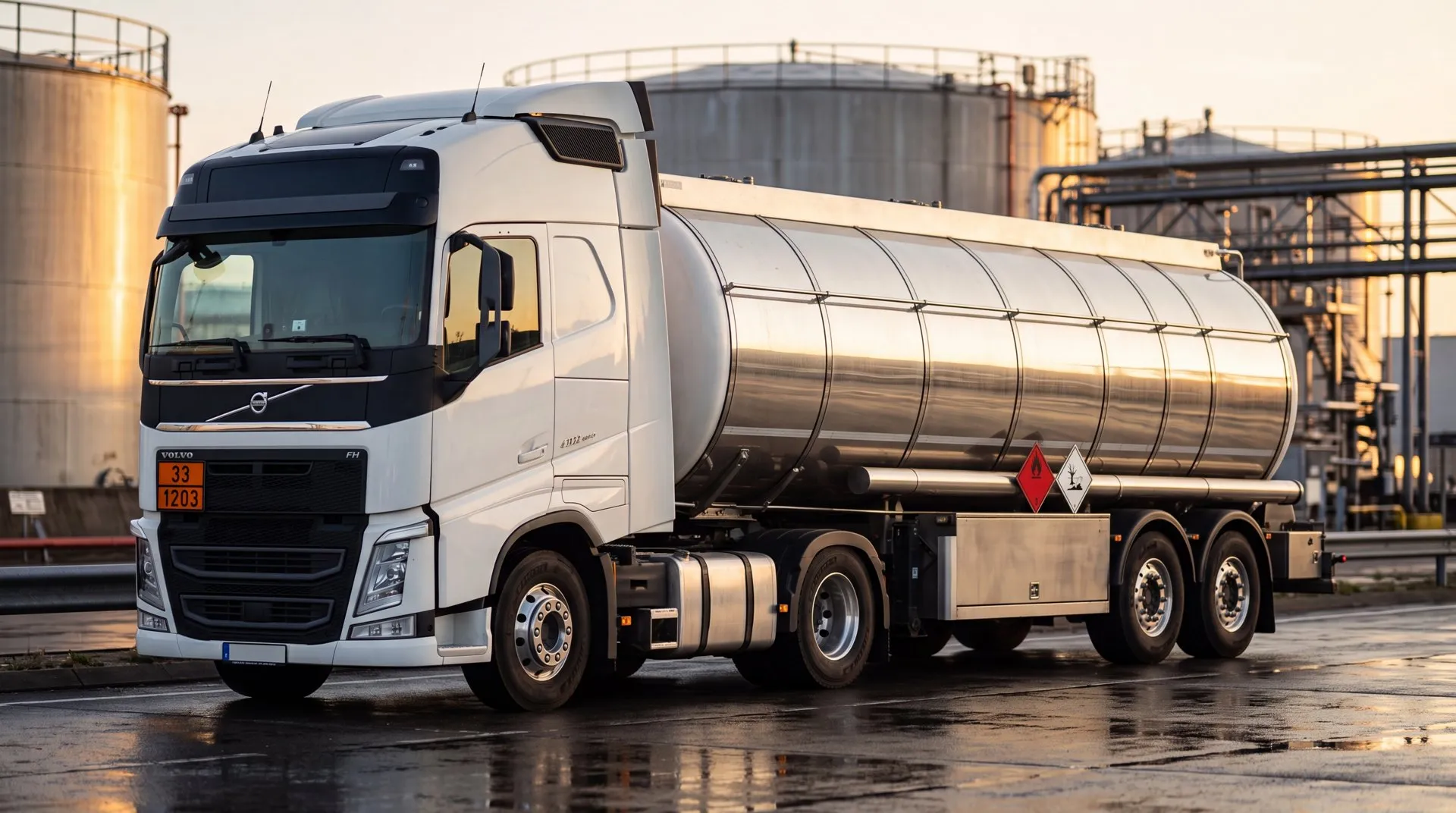
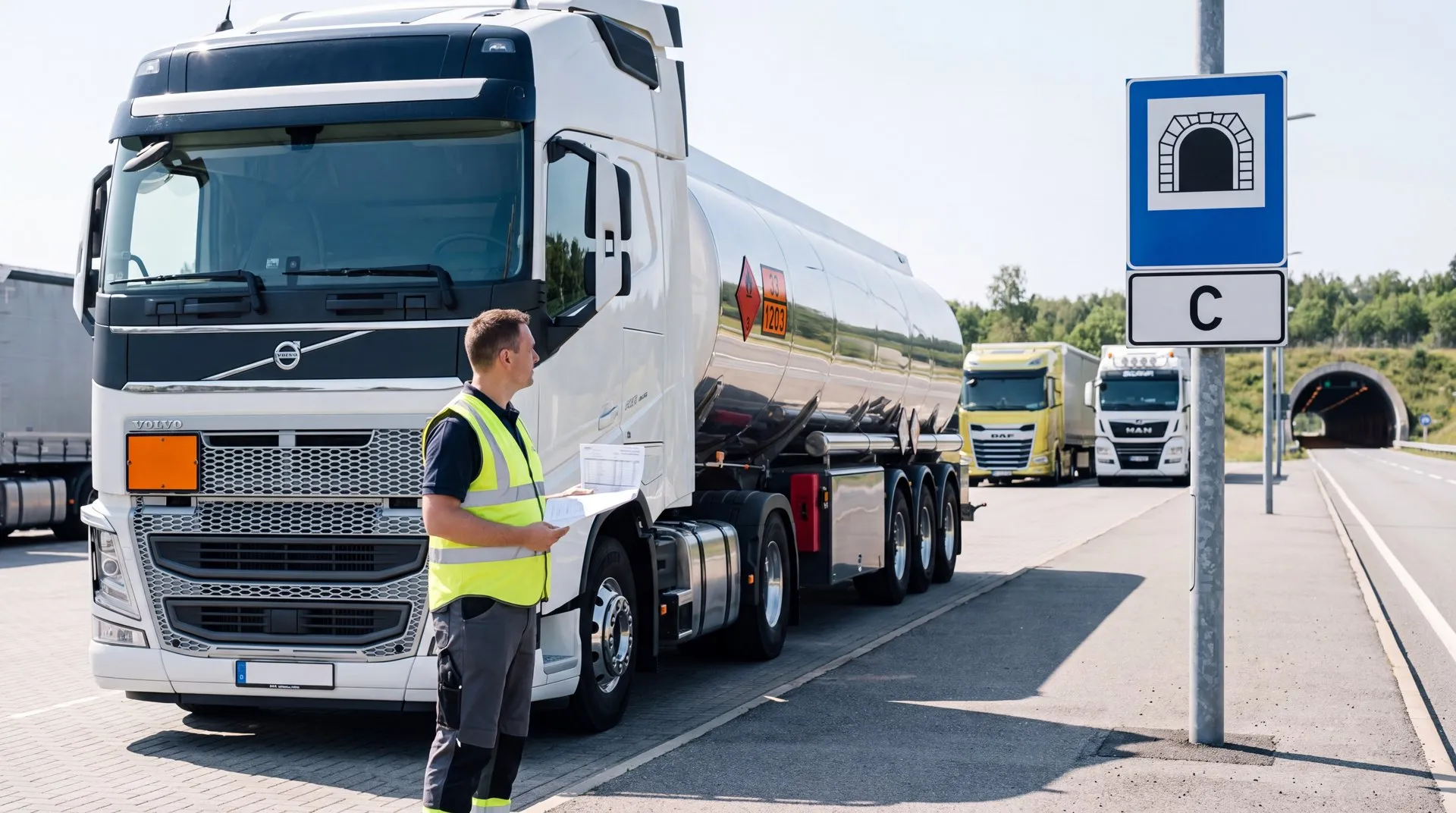
A transport unit carrying dangerous goods displays two rectangular orange-coloured plates — front and rear, set in a vertical plane, perpendicular to the longitudinal axis, clearly visible. When packages are carried the plates stay blank. Placards go on a vehicle carrying packages only for Class 1, other than Division 1.4 compatibility group S, and for Class 7 in packagings or IBCs, other than excepted packages — on both sides and at the rear. Plates that do not relate to the goods carried are removed or completely covered.
The plate is reflectorized, 40 cm at the base and 30 cm high, with a black border 15 mm wide. Where the available surface will not take it, the base may go down to 300 mm, the height to 120 mm and the border to 10 mm.
What the carrier checks before departure
Under 1.4.2.2.1 the carrier ascertains that the goods are authorized for carriage, that the consignor has supplied all the prescribed information and the documentation is on board, that the vehicle and the load show no obvious defects, leakages or cracks, that the vehicle is not overloaded, that the placards, marks and plates are in place, and that the prescribed equipment is on the transport unit. Under 1.4.2.2.2 the carrier may rely on data supplied by other participants, but on observing an infringement shall not forward the consignment under 1.4.2.2.3 until the matter has been rectified.
Almost everything on this list is bought and arranged once. Instructions in writing in the languages of the crew, orange-coloured plates and hazard labels in the size and execution required by ADR are available in our shop. What exactly must be on board is covered in detail in the knowledge base — documents on board and emergency equipment.