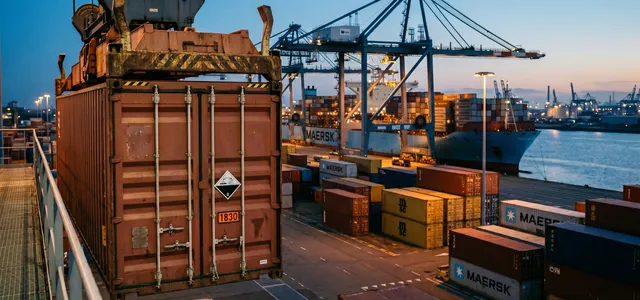




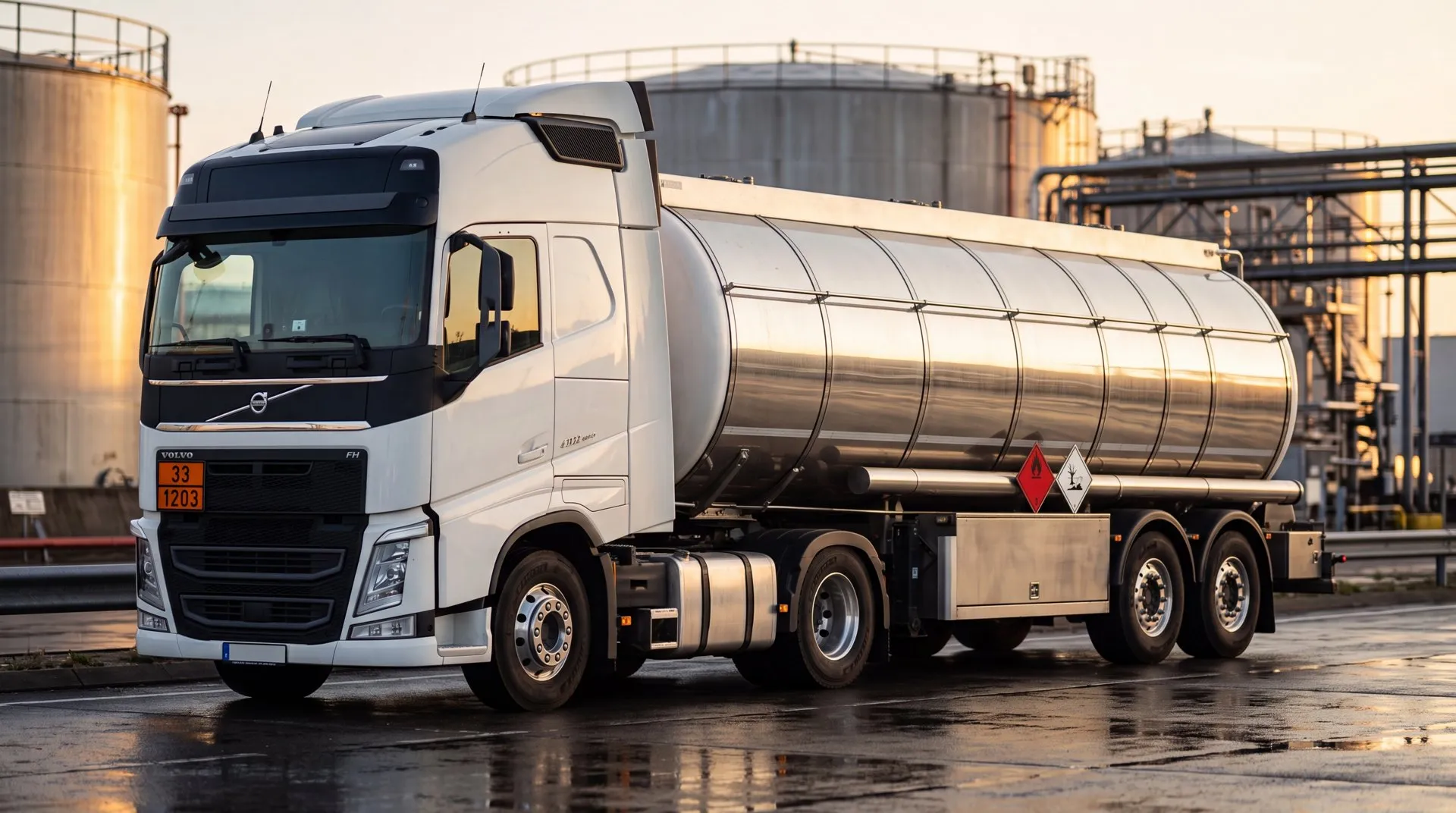
As long as a company carries dangerous goods in drums and jerricans, ADR remains a matter of documents, labels and equipment. As soon as a tank appears — your own tank-vehicle, a leased tank-container or a loading gantry — there are noticeably more requirements, and they are distributed differently. Here is what exactly changes.
Which tanks exist
ADR distinguishes several types, and the rules for construction and inspection depend on the type.
- Fixed tank — a tank with a capacity of more than 1,000 litres permanently attached to a vehicle, which thereby becomes a tank-vehicle.
- Demountable tank — fitted to a vehicle but not designed to be transhipped when full.
- Tank-container — meets the definition of a container and is transhipped between modes.
- Portable tank — a multimodal tank under the UN rules, familiar from sea transport.
- Battery-vehicle and MEGC — assemblies of receptacles linked by a manifold, most often for gases.
Every tank carries a four-part code — type, calculation pressure, openings and safety devices (4.3.3.1.1 for gases, 4.3.4.1.1 for the rest). A substance may be carried only in a tank with the code shown for it in Column (12) of Table A, or in a tank that counts as stricter under the hierarchy in 4.3.3.1.2 and 4.3.4.1.2. The check “does this tank suit this load” starts with the code.
Vehicle approval
For packages an ordinary truck needs no approval, the one exception being Class 1, where explosives call for an EX/II or EX/III vehicle. For tanks approval is needed almost always. Chapter 9.1 defines two types.
- FL — for liquids with a flash-point of not more than 60 °C in fixed or demountable tanks with a capacity exceeding 1 m³, or in tank-containers and portable tanks with an individual capacity exceeding 3 m³. Diesel fuel, gas oil and heating oil (light) of UN 1202 with the flash-point specified in standard EN 590 are excluded here. The same type covers flammable gases, where MEGCs join the list, a battery-vehicle with a total capacity exceeding 1 m³ intended for flammable gases, and hydrogen peroxide stronger than 60 % (UN 2015).
- AT — for other dangerous goods in tanks of the same sizes, MEGCs included, and for a battery-vehicle with a total capacity exceeding 1 m³ that is not an FL vehicle.
Conformity is attested by a certificate of approval issued by the competent authority of the country of registration after a first inspection (9.1.2.1). The vehicle then undergoes an annual technical inspection, and the certificate expires no later than one year after the inspection that preceded its issue (9.1.2.3, 9.1.3.4). After the nominal expiry date the vehicle may not carry dangerous goods until it holds a valid certificate again.
The tank itself has a separate schedule — periodic and intermediate inspections under chapter 6.8, which the annual vehicle inspection neither replaces nor makes more frequent. The date of the next inspection is on the tank plate, and two participants look at it — the filler before filling (1.4.3.3) and the carrier before departure (1.4.2.2.1).
Marking
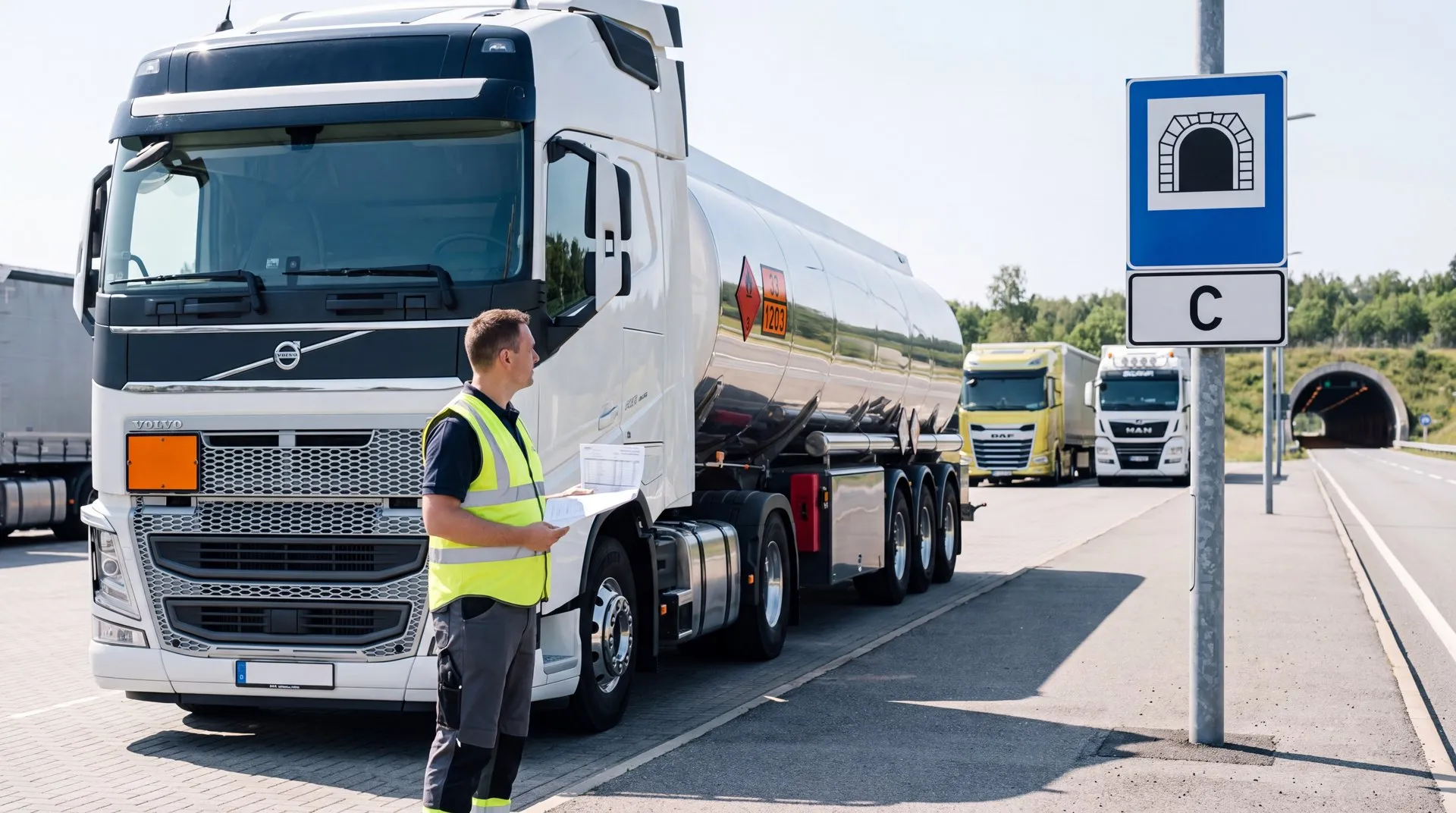
With packages the transport unit carries two blank orange plates, one at the front and one at the rear (5.3.2.1.1). With a tank, two numbers appear on the plates — the hazard identification number on top and the UN number below. Such plates go on the sides of each tank, each tank compartment and each element of a battery-vehicle (5.3.2.1.2). Where the transport unit carries only one dangerous substance and no non-dangerous substance, the side plates are not needed, provided the numbers appear on the plates at the front and rear (5.3.2.1.6).
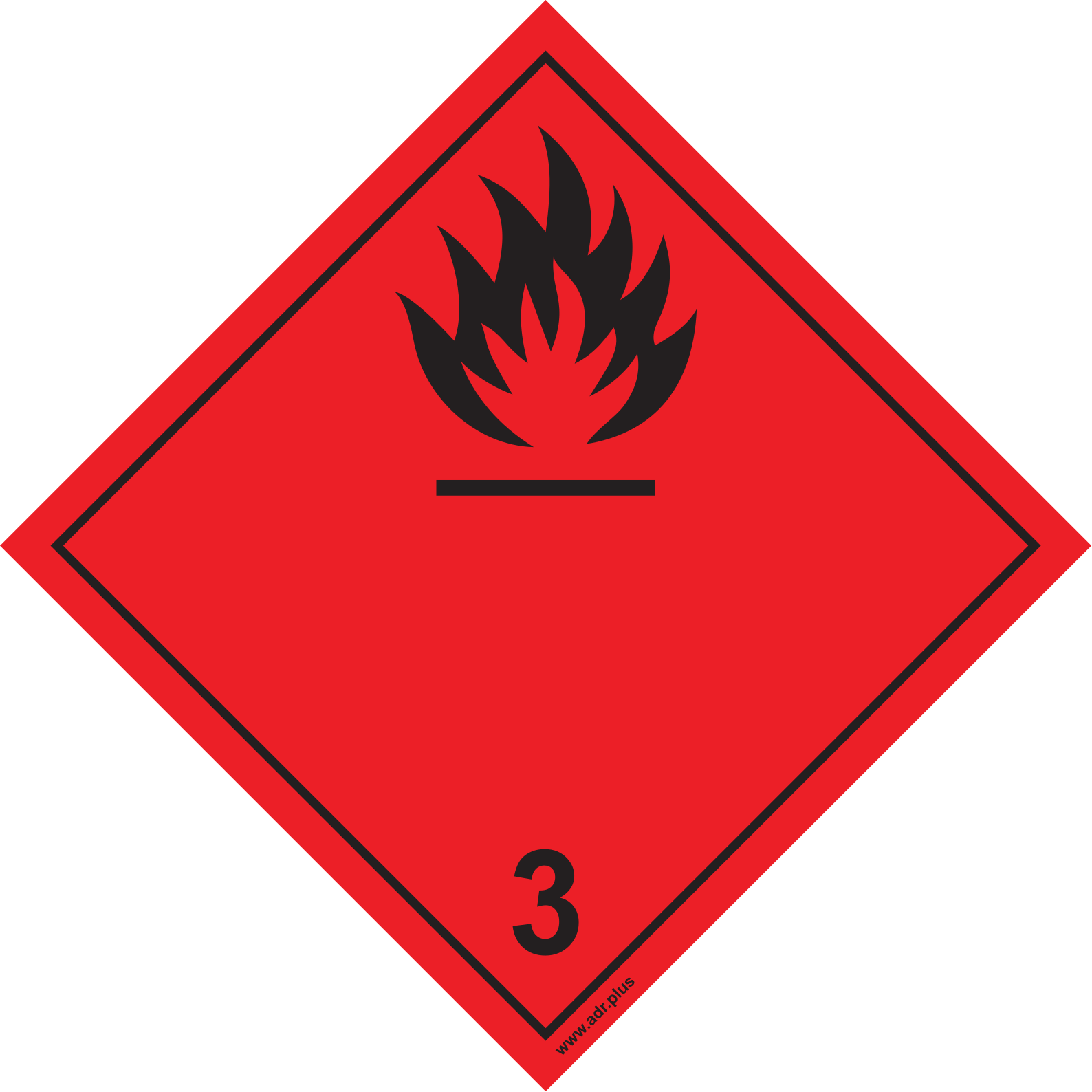
In addition to the plates, placards are affixed to the tank — on both sides and at the rear (5.3.1.4.1). When the compartments hold different goods, the placards go along each side at the position of the relevant compartments. Environmentally hazardous substances and elevated temperature substances add marks of their own.
An empty uncleaned tank is marked exactly as when full, because the plates and placards relate to the residues as well. They may be removed or completely covered only once they match neither the load nor its residues (5.3.1.1.6, 5.3.2.1.8).
The driver
The basic certificate is not enough. The tank specialization course is taken by drivers carrying dangerous goods in fixed or demountable tanks with a capacity exceeding 1 m³, in tank-containers, portable tanks or MEGCs with an individual capacity exceeding 3 m³ on a transport unit, and by drivers of battery-vehicles with a total capacity exceeding 1 m³ (8.2.1.3). The specialization is endorsed on the driver’s certificate, and without it carriage in tanks is not allowed.
A new participant — the filler
Carriage in tanks brings a role that packages do not have. Paragraph 1.4.3.3 sets out what the filler has to do.
- Before filling, ascertain that the tank and its equipment are technically in a satisfactory condition.
- Ascertain that the date specified for the next inspection of the tank has not expired.
- Fill the tank only with the dangerous goods authorized for carriage in it.
- Comply with the requirements concerning dangerous goods in adjoining compartments.
- Observe the permissible degree of filling, filling ratio or mass of contents per litre of capacity, whichever applies to the substance being filled.
- After filling, make sure that all closures are closed and that there is no leakage.
- Leave no dangerous residue of the filling substance on the outside of the tank.
- Ensure that the placards, marks, orange-coloured plates and labels are affixed in accordance with chapter 5.3.
- When filling vehicles or containers with dangerous goods in bulk, comply with chapter 7.3.
The filler is whoever actually fills — a fuel depot, a chemical plant, a warehouse with a loading gantry. The fact that the tank belongs to the carrier does not release it from these obligations.
The threshold above which a security plan is required
A tank means large quantities, and ADR also looks at large quantities from the standpoint of protection against deliberate misuse. Table 1.10.3.1.2 lists high consequence dangerous goods. For tanks the threshold in most rows is the same — more than 3,000 litres.
- Flammable, non-toxic gases of Class 2 whose classification code includes only the letters F or FC.
- Flammable liquids of Class 3, packing groups I and II, including petrol.
- Substances of Classes 4.2 and 4.3, packing group I.
- Oxidizing liquids of Class 5.1, packing group I.
- Perchlorates, ammonium nitrate, ammonium nitrate fertilisers and ammonium nitrate emulsions, suspensions or gels.
- Corrosive substances of Class 8, packing group I.
Three entries have a threshold of zero — toxic gases of Class 2, desensitized explosives of Class 3 and toxic substances of Class 6.1 packing group I count as high consequence dangerous goods in any quantity.
An ordinary petrol tanker holds ten times the threshold. That means the carrier, the consignor and the filler must adopt, implement and comply with a security plan (1.10.3.2.1), while the vehicle and its cargo need theft protection kept operational and effective at all times (1.10.3.3).
A move to tanks is worth planning as a project — with a check of tank codes against the range of goods, an inspection schedule, driver training and a security plan. More on the tank code and vehicle approval in the knowledge base — tank code and vehicle and tank certification.