
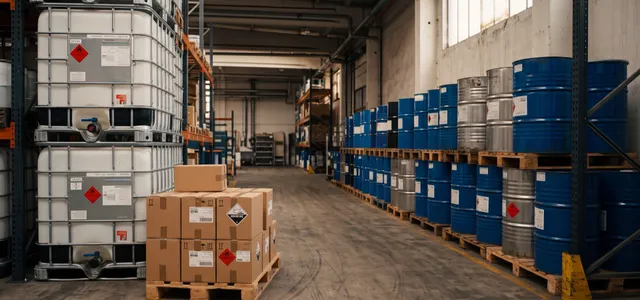




Chapter 7.5 covers what happens on the loading dock and on the truck bed — how to verify the vehicle, how to stow mixed classes, how to fasten the cargo so that it does not move, and what per-substance special provisions apply.
Before loading (7.5.1).
- Vehicle is the correct category for the goods (EX, FL, AT), and the ADR Certificate of Approval is current
- Vehicle is clean, undamaged, no leaks from the previous load
- Orange plates, placards, transport document, written instructions, PPE, fire extinguishers — all present and serviceable
- For tanks — last inspection date not expired, safety valves operational
During loading.
- Check UN number, hazard labels and packaging condition of every package
- No damaged packages, no leaks — a leaking package does not load
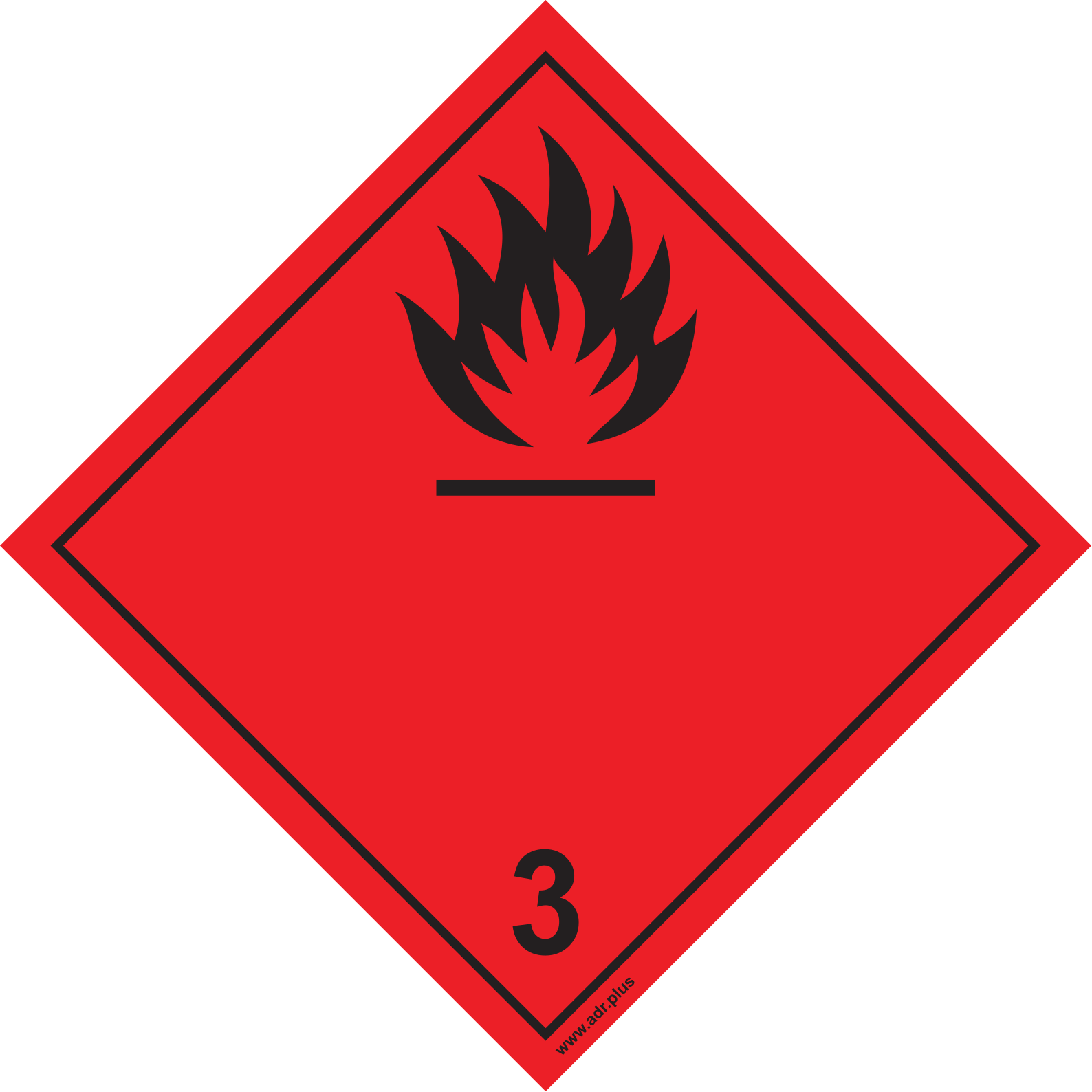
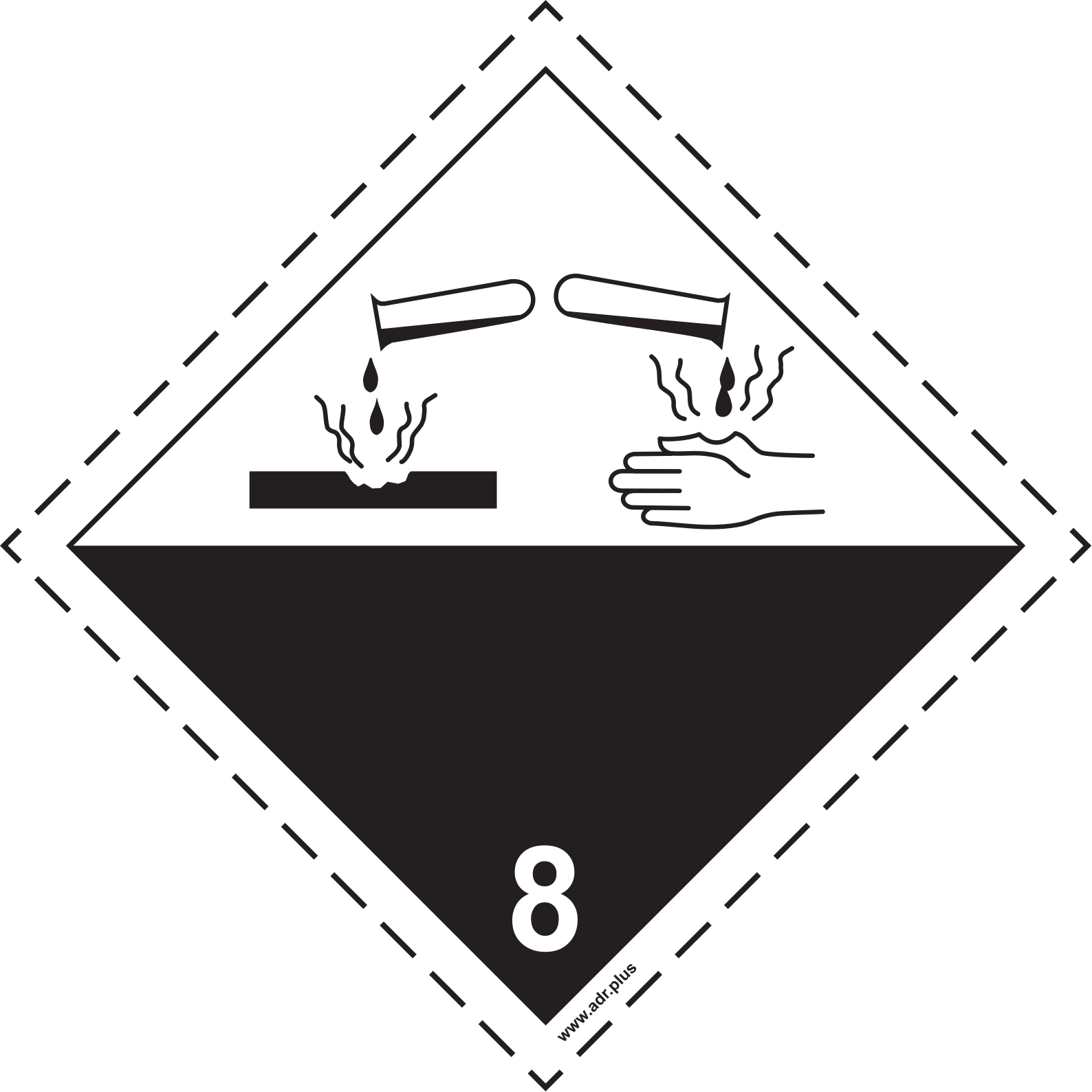
- Respect the mixed-loading rules of 7.5.2 (label matrix in 7.5.2.1, including the combined labels 4.1 + 1 and 5.2 + 1, and the compatibility groups of class 1 in 7.5.2.2)
- Apply the special provisions CV1–CV38 from Column 18 of Table A — e.g.
CV13(after a leak or spillage the vehicle is not re-used until it has been thoroughly cleaned and, if necessary, disinfected or decontaminated),CV28(precautions with respect to foodstuffs, other articles of consumption and animal feeds, see 7.5.4),CV33radioactive stowage - Smoking is prohibited during handling operations in the vicinity of vehicles or containers and inside them — the prohibition also covers electronic cigarettes and similar devices (7.5.9)
- Before tanks are filled or emptied with flammable gases, or with liquids having a flash-point of 60 °C or below, or with UN 1361 carbon or carbon black packing group II — a good electrical connection to earth from the chassis, the portable tank or the tank-container, and a limited rate of filling (7.5.10). The engine is shut off during loading and unloading, unless it has to drive the pumps and the law of the country allows it (8.3.6)
Securing (7.5.7.1). Packages containing dangerous substances and unpackaged dangerous articles must be secured by suitable means capable of restraining them (fastening straps, sliding slatboards, adjustable brackets) so that during carriage no movement changes the orientation of the packages or damages them. ADR itself states no acceleration figures — the requirement is deemed to be complied with if the cargo is secured in accordance with EN 12195-1:2010, a standard referenced by 7.5.7.1, whose calculation method (acceleration coefficients, friction, lashing forces) is not part of the ADR text. Methods.
- Blocking against the front wall and fixed partitions
- Lashing with tensioned straps (EN 12195-2 webbing) — top-over or direct
- Friction locking with anti-skid mats
- Combinations of the above
Voids may also be filled with dunnage, or the load blocked and braced. Restraints must not be over-tightened to the point of damaging or deforming the package. The number and strength of lashings are calculated from the cargo mass and the acceleration coefficients of EN 12195-1:2010 — figures of the standard, not of ADR.
After unloading. If some of the contents are found to have escaped, the vehicle or container is cleaned as soon as possible and in any case before reloading (7.5.8.1). Vehicles and containers loaded in bulk are cleaned before reloading unless the new load is the same goods (7.5.8.2). While a residue remains, the transport document carries the words “EMPTY, UNCLEANED” or “RESIDUE, LAST CONTAINED” (5.4.1.1.6.1). Empty tank-vehicles, tank-containers and MEMUs that are uncleaned and not degassed, and empty vehicles and containers for carriage in bulk that are uncleaned, keep the placards and orange plates required for the previous load (5.3.1.6.1, 5.3.2.1.7). Plates that no longer relate to the goods carried or their residues are removed or covered (5.3.2.1.8).
Common mistake — relying on friction alone, with no anti-skid mat and no lashings, because the cargo “feels stable”. 7.5.7.1 requires the goods to be held by suitable restraining means, and friction between a bare load bed and the pallet is not one of them. In the first hard brake the load slides forward — with possible fatal consequences for the driver.
References — ADR 2025 7.5.1 (general loading), 7.5.2 (mixed loading), 7.5.7 (cargo securing), 7.5.8 (cleaning after unloading), 7.5.9 (smoking), 7.5.10 (electrostatic charges), 8.3.6 (engine shut off), Table A Column 18 (CV codes), EN 12195-1:2010 (securing calculation — a standard referenced by 7.5.7.1, not part of ADR), EN 12195-2 (webbing — standard outside ADR).