





ADR anticipates that some transport operations do not fit the standard rulebook, and its own escape valve is a single one — the temporary derogations of 1.5.1, agreed between the competent authorities of contracting parties. National relief for domestic carriage is not an ADR mechanism at all — ADR 1.5.2 is reserved and empty. Inside the EU that route runs through Article 6 of Directive 2008/68/EC. Both are narrow in scope. Neither waives ADR wholesale.
1.5.1 — Temporary derogations (the M-numbered agreements).
Under Article 4, paragraph 3 of ADR the competent authorities of contracting parties may agree directly among themselves to authorise certain transport operations in their territories by temporary derogation from ADR requirements, provided safety is not compromised. The authority that took the initiative notifies the UNECE Secretariat, which brings the derogation to the attention of the other contracting parties (1.5.1.1). Each agreement follows the same pattern.
- Is published by UNECE under a number
Mfollowed by three digits (e.g.M345,M356) — the numbering is UNECE practice, not a provision of ADR - Lists the signing parties by country code
- Runs for no more than five years from the date it enters into force, and ceases automatically on the date a relevant amendment to ADR enters into force (1.5.1.2)
- Covers a narrow scope — a specific UN number, packaging type, or operation — not general ADR relief
Carriage on the basis of a temporary derogation is still carriage in the sense of ADR (1.5.1.3).
How an operator uses an M-agreement. The transport document carries the declaration required by the terms of the agreement — 5.4.1.1.1 (i) reserves a field for exactly that, in practice the wording prescribed by the agreement itself, e.g. Carriage agreed under the terms of section 1.5.1 of ADR (M356). Every country the consignment enters (origin, transit, destination) must have signed the agreement on the date of transport. The current register is published by UNECE and updated continuously. Signatures can be added or withdrawn.
National derogations — EU law, not ADR. ADR 1.5.2 is reserved — the agreement gives no single contracting party a route to derogate on its own. Inside the EU that route is Article 6 of Directive 2008/68/EC. A Member State may request a derogation for carriage within its own territory — small quantities of certain dangerous goods, excluding medium- and high-activity radioactive substances, or local transport over short distances — and the Commission decides whether to authorise it and add it to the list of national derogations in Annex I, Section I.3 of the directive for road transport. An authorised derogation is valid for no more than six years and is reviewed when the Member State asks for an extension. Separately, a Member State may exceptionally issue individual authorisations for clearly defined, time-limited operations in its territory (Article 6(5)), and may authorise languages other than those in the Annexes for transport performed within its territory (Article 6(1)).
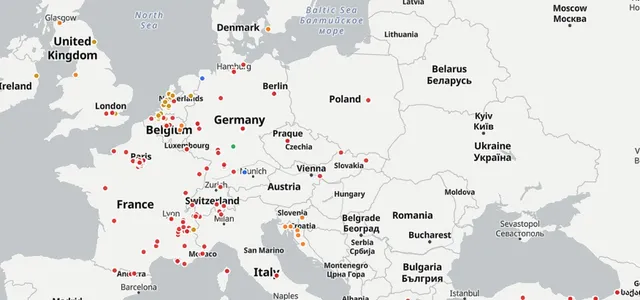
Latvia, Lithuania and Estonia hold no road derogations. In the consolidated text of Directive 2008/68/EC the national derogations in Annex I, Section I.3 belong to Austria, Belgium, Denmark, Finland, France, Germany, Greece, Hungary, Ireland, the Netherlands, Portugal, Spain and Sweden. There is no Latvian, Lithuanian or Estonian entry. For domestic carriage in the three Baltic states, therefore, the ADR requirements apply as transposed, and no national relief can be relied on.
What derogations do not cover. A derogation is a targeted change to specified requirements for a defined operation, not a general waiver. Unless the derogation itself says otherwise, everything it does not name stays in force — including the safety adviser obligation of 1.8.3 and the training requirements of Chapter 1.3.
Domestic versus international. An Article 6 national derogation applies inside one Member State only. For international movement the route is the temporary derogation of 1.5.1. Carriage between countries relying on a national-only derogation is not compliant.
A common mistake — relying on a national derogation of the origin country for an international shipment. It stops at the border. Once the truck leaves the territory, full ADR applies unless a 1.5.1 temporary derogation covers the same operation and has been agreed by every country on the route.
References — ADR 2025 1.5.1.1–1.5.1.3 (temporary derogations), 1.5.2 (reserved), 5.4.1.1.1 (i) (declaration required by a special agreement). UNECE register of ADR multilateral agreements. Directive 2008/68/EC Article 6 and Annex I, Section I.3 (national derogations for road transport).