




A transport unit (1.2.1) is a single motor vehicle, or a motor vehicle coupled with one trailer or semi-trailer. ADR limits the configuration.
- One trailer only per transport unit on ADR routes (8.1.1). A tractor + semi-trailer + full trailer (“road train”) is not permitted for dangerous goods even if each unit is individually approved.
- The combination must be mechanically and operationally compatible — approved coupling, working brakes, tyres rated for the gross weight (this comes from general road-transport rules, not from ADR itself).
Each element of the unit is certified separately. 8.1.2.2 (a) requires the certificate of approval of 9.1.3 to be carried “for each transport unit or element thereof” — so a tank semi-trailer and the motor vehicle that tows it each have their own certificate where Part 9 requires one. Vehicles that are not EX/II, EX/III, FL, AT or MEMU need no ADR certificate at all (NOTE to 9.1.2), and only two provisions of chapter 9.2 reach them — braking equipment (9.2.3.1.1) and the speed limitation device (9.2.6), see 9.2.1.1.
Category matching — the category follows the goods and the means of containment, not the position in the combination. A sheeted trailer with packages of class 3 is not an ADR category vehicle and needs no certificate of approval. A fixed tank over 1 m³ of a liquid with a flash-point of not more than 60 °C (except diesel fuel, gas oil and heating oil (light) — UN 1202 — complying with standard EN 590) makes the tank vehicle an FL vehicle. The FL construction regime brings electrical equipment for hazardous areas per 9.7.8, electrical bonding of the tank to the chassis per 9.7.4 and — for packing group I and II flammable liquids and for liquefied and compressed flammable gases with F in the classification code — engine-compartment fire suppression and wheel thermal protection per 9.7.9.
Mixed goods across tractor and trailer. The 7.5.2 mixed-loading prohibitions bind packages loaded together in the same vehicle or container — the motor vehicle and its trailer are separate vehicles of one transport unit, so the prohibition is checked for each of them, not for the combination as a whole. Quantity thresholds, by contrast, are counted per transport unit — the exemption limits of 1.1.3.6, the limited-quantities marking of 3.4.13 (which may be dispensed with when the total gross mass of LQ packages does not exceed 8 tonnes per transport unit, 3.4.14), and orange-plate requirements.
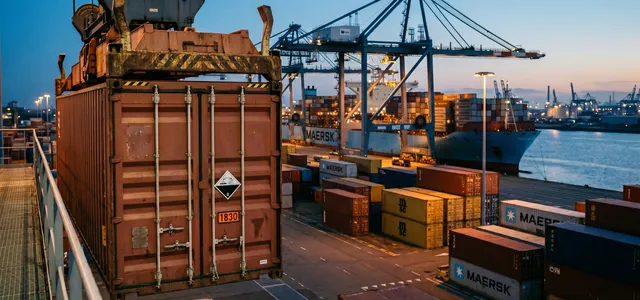
Containers on chassis. With a tractor, a container chassis and an ISO tank container, the container is the “cargo transport unit” in the intermodal sense, while for ADR road certification the chassis is the trailer and the rules scale to the cargo item on it.
Common mistake — coupling two trailers behind one tractor with class 3 packages on both. A road train is not a valid ADR transport unit — 8.1.1 caps the combination at tractor + one trailer. Individual approvals do not change the limit, and a roadside inspection stops the whole combination.
References — ADR 2025 1.2.1 (transport unit), 8.1.1 (one-trailer limit), 8.1.2.2 (a) (certificate for each element of the unit), 9.1.2 and 9.1.3 (approval and certificate), 9.2.1.1 (scope of chapter 9.2), 9.7 (FL and AT tanks), 7.5.2 (mixed loading), 1.1.3.6 (quantity limits per transport unit), 3.4.13–3.4.14 (limited-quantity marking and the 8-tonne threshold).