


From 24 June 2026, inspectors across the European Union check dangerous goods transport against one form and classify infringements on one scale. The report now records not only the infringement, but also the participant in the carriage responsible for it. Here is how the new check works, what the official report form looks like, and how to prepare.
What happened
Roadside checks of dangerous goods transport in the EU are governed by Directive (EU) 2022/1999 on uniform procedures for checks on the transport of dangerous goods by road (the codification of the former Directive 95/50/EC). On 23 June 2025 the European Commission adopted Commission Delegated Directive (EU) 2025/1801, which replaced both of its annexes. Annex I — the checklist for roadside checks, and Annex II — the list of infringements by risk category. Member States must apply the new rules from 24 June 2026 (Article 2(1) of Directive 2025/1801).
Checks are random and must cover “an extensive portion of the road network” (Article 4(2)). You can meet an inspection on any EU road — and the form will be the same in Latvia, Lithuania or Germany.
What exactly is checked — the 31 points of the form
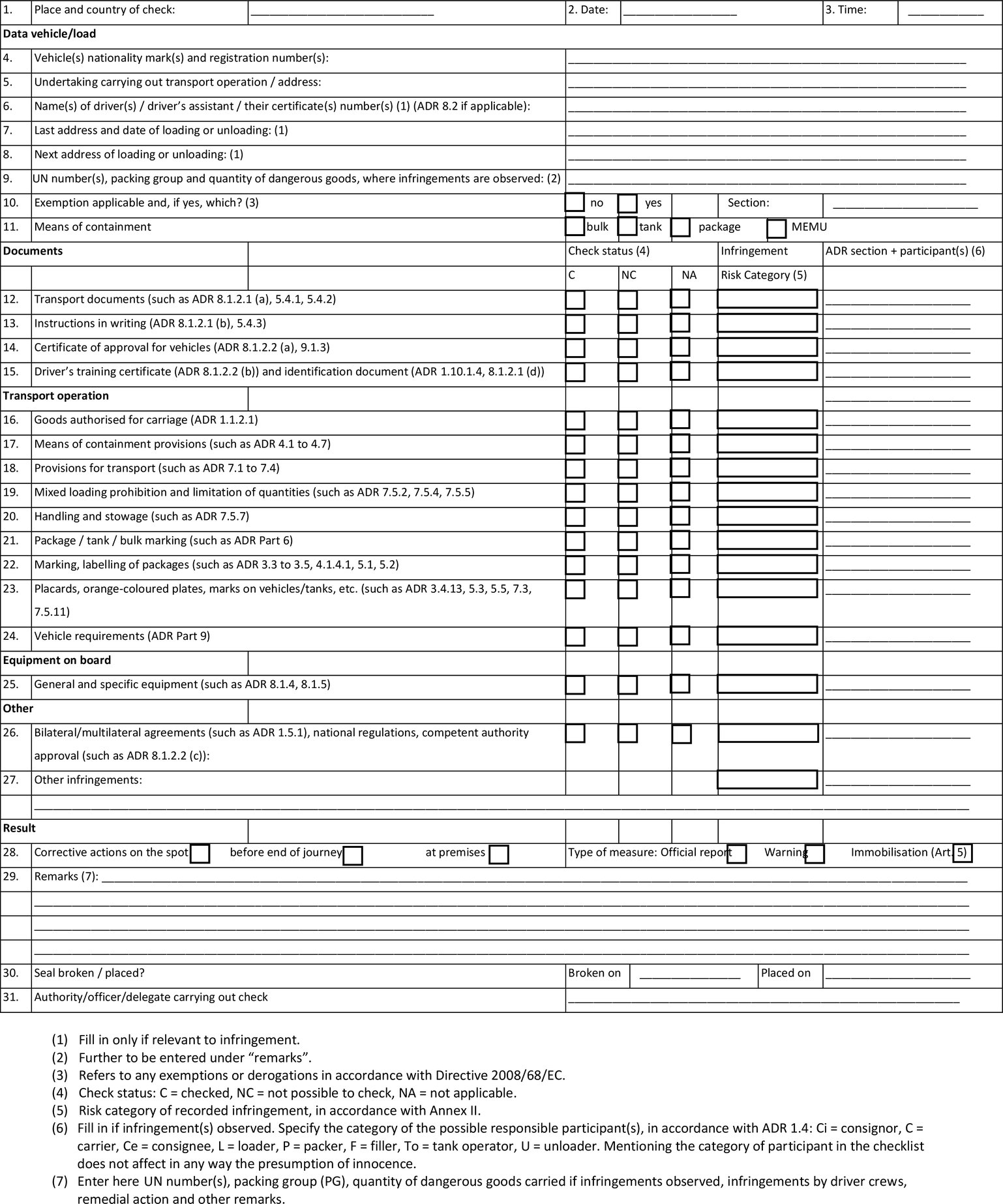
The inspector works through the official checklist (Annex I). It has 31 lines grouped into sections.
- Data vehicle/load (items 1-11) — place and country of check, registration numbers, the undertaking, the driver and their certificate, last and next loading or unloading addresses, UN numbers and quantities, applicable exemptions, means of containment — bulk, tank, package or MEMU.
- Documents (items 12-15) — transport documents, instructions in writing, certificate of approval for vehicles, driver’s training certificate and identification document.
- Transport operation (items 16-24) — whether the goods are authorised for carriage, means of containment provisions, mixed loading prohibitions and quantity limits, handling and stowage, package marking and labelling, placards and orange-coloured plates, vehicle requirements.
- Equipment on board (item 25) — per ADR and the instructions in writing.
- Other and result (items 26-31) — bilateral agreements, other infringements, measures taken, remarks, seals, the authority carrying out the check.
A practical detail from Article 4(1) — a copy of the completed checklist, or a certificate showing the result of the check, is given to the driver — and presenting it at the next control simplifies the check or lets the driver avoid it where possible. Teach your drivers to keep that piece of paper.
This is the official form.
Three risk categories
The inspector assigns every established infringement to one of three risk categories (Annex II). The category also determines how urgent the measures are.
| Category | What it means | Examples from the list |
|---|---|---|
| I — highest risk | Normally immediate measures, up to immobilisation of the vehicle on the spot | leakage of dangerous goods, carriage of prohibited goods, missing mandatory documents on board, driver without a valid training certificate, no safety adviser appointed where one is required, non-compliance with ADR 1.10 security provisions |
| II — medium risk | Rectification on the spot where feasible, otherwise no later than the end of the current transport operation | missing fire extinguishers or instructions in writing, damaged packagings, overdue tests of packagings and tanks, incorrect marking, supervision and parking failures, staff training failures |
| III — low risk | Measures may be taken later, by the undertaking | placard or letter sizes below standard, the driver’s certificate exists but is not on board, no photo identification for a crew member, late submission of reports |
The list is non-exhaustive — infringements not named in it are classified by the category descriptions, and the inspector may upgrade or downgrade the category of a specific infringement depending on the circumstances.
Note — operating without a dangerous goods safety adviser is a category I infringement, on a par with a leakage. If a company’s activities include consigning, carrying, packing, loading, filling or unloading dangerous goods, an adviser must be appointed (ADR 1.8.3.1).
Immobilisation and checks at premises
Vehicles with infringements — category I first of all — may be immobilised on the spot or at a designated place and required to be brought into conformity before continuing the journey (Article 5). For vehicles from outside the EU, refusal of entry into the Union is also possible. The directive itself sets no fines — penalties are a matter of national law in each country and apply “without prejudice” to the measures under the directive.
Checks are not limited to the road. Under Article 6, control may come to the premises of the undertaking — both preventively and after infringements recorded at the roadside. If an infringement is established during such a check, the transport must be brought into conformity before the goods leave the undertaking.
The report names the responsible participant
The biggest change for businesses is in the form itself. Each checked item has an “ADR section + participant(s)” column — the inspector records the ADR section and the category of the participant who may be responsible, per ADR 1.4, namely Ci — consignor, C — carrier, Ce — consignee, L — loader, P — packer, F — filler, To — tank operator, U — unloader (footnote 6 of the form — the same footnote notes this does not affect the presumption of innocence).
The previous form (in use until 24 June 2026) recorded one overall risk category per check and did not tie infringements to participants. Now the risk category is recorded per infringement, and the responsible participant’s role is visible right in the report. We break down the participants’ obligations under ADR Chapter 1.4 in the video on our home page and in Transportation of dangerous goods — ADR requirements.
How to prepare — a self-check by role
- Identify your roles. Do you consign, pack, load, fill, carry, receive or unload dangerous goods? ADR 1.4 has a list of obligations for each role.
- Verify the safety adviser appointment (ADR 1.8.3.1) — its absence is now explicitly a category I infringement.
- Go through the journey documents — transport document, instructions in writing, the driver’s and the vehicle’s certificates (items 12-15).
- Walk the form with an inspector’s eyes — from package marking to placards and load securing (items 16-25).
- Train staff before they take up duties and keep training records (ADR 1.3.1, 1.3.3) — training failures fall into category II.
- Run an internal check at your site — the inspection may come to the premises, and a non-compliant vehicle will not leave the gates.
Not sure which obligations rest with your company and whether they are covered? That is the job of a dangerous goods safety adviser — check your company with ADRplus — the ADR consultant service.
Sources
- Commission Delegated Directive (EU) 2025/1801 of 23 June 2025 — the new checklist (Annex I) and the list of infringements (Annex II).
- Directive (EU) 2022/1999, consolidated version of 24.06.2026 — uniform check procedures — Articles 4-6 (checklist, immobilisation, checks at premises).
- Obligations of the participants are in ADR 2025, Chapter 1.4 — see Transportation of dangerous goods — ADR requirements.