

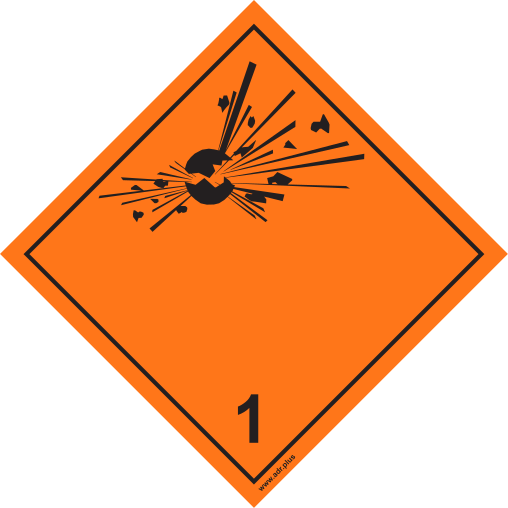
Class 1 — explosive substances and articles
Substances and articles that can explode, deflagrate or produce a pyrotechnic effect — divided into six divisions (1.1–1.6) by the scale of hazard.
What belongs in this class?
Class 1 covers explosive substances and articles — material capable, by chemical reaction, of producing gases at such a temperature, pressure and speed as to damage its surroundings, together with the articles that contain them. (ADR 2.2.1.1.1)
It also takes in pyrotechnic substances — designed to produce heat, light, sound, gas or smoke through non-detonating, self-sustaining exothermic reactions — and any substance or article manufactured with a view to producing a practical explosive or pyrotechnic effect. (ADR 2.2.1.1.1)
Some material sits outside the class. Substances that are not themselves explosive but may form an explosive mixture of gas, vapour or dust are not Class 1, and wetted explosives whose water or alcohol content exceeds the specified limits, or which contain plasticizers, are assigned instead to Class 3 or Class 4.1. (ADR 2.2.1.1.1)
Classification rules
- ADR 2.2.1.2.1
Explosive substances that are unduly sensitive or liable to spontaneous reaction, and any explosive substance or article that cannot be assigned to a name or n.o.s. entry in Table A of Chapter 3.2, are not accepted for carriage at all.
- ADR 2025
The classification code is always a division number plus a compatibility letter (for example 1.1D, 1.4S), and that pairing drives everything downstream — including the danger label, which is No. 1 for divisions 1.1–1.3 and No. 1.4, 1.5 or 1.6 for those divisions respectively.
- ADR 2.2.1.1.6
The compatibility group governs which explosives may be loaded together. The group definitions themselves set out where articles may be packed with their own means of initiation and where combined packages must be re-assigned (e.g. groups C, D and E packed together become group E).
- ADR 2.2.1.1.1
Devices holding explosive or pyrotechnic substance in such small quantity, or of such a character, that accidental ignition in carriage would cause no external effect by projection, fire, smoke, heat or loud noise fall outside the Class 1 requirements.
Packing groups in this class
Class 1 is not divided into packing groups. Instead every entry carries a classification code built from two parts — a division describing the hazard, and a compatibility group letter describing what may safely travel together.
Six divisions rank the hazard. Division 1.1 has a mass explosion hazard (affecting almost the entire load virtually instantaneously), 1.2 a projection hazard but not a mass explosion, 1.3 a fire hazard with minor blast or projection. Division 1.4 presents only a slight hazard confined largely to the package, 1.5 covers very insensitive substances with a mass explosion hazard, and 1.6 extremely insensitive articles with no mass explosion hazard. (ADR 2.2.1.1.5)
The compatibility group is a letter from A to S — for example A for a primary explosive substance, D for a secondary detonating substance or black powder without means of initiation, G for most pyrotechnics, and S for material packed so that any accidental effects stay inside the package. Each substance or article, in its specified packaging, is assigned to one compatibility group only. (ADR 2.2.1.1.6)
Class 1 in Table A
Transport categories, tunnel codes and quantity reliefs across the 384 Table A entries of this class.
Transport categories
The category feeds the 1.1.3.6 calculation — the lower the number, the stricter the limit.
Tunnel codes
The column 15 code decides which tunnel categories the load may pass.
Limited quantities (LQ)
entries allow LQ
of 384 in the class
For the rest there is no relief — the full ADR applies to any quantity.
Excepted quantities (EQ)
entries allow EQ
of 384 in the class
For the rest there is no relief — the full ADR applies to any quantity.
Marking and signs for Class 1
What must be on every package — and what the transport unit carries on the road.
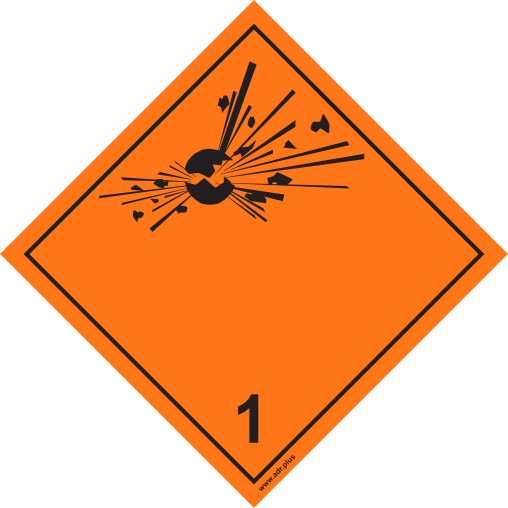
On the package
Every package carries the danger label of its Table A entry and the UN number with the letters "UN" (ADR 5.2.1, 5.2.2).
On the transport unit
Orange plates at the front and rear — and for tanks and bulk also enlarged placards 250 × 250 mm on the sides and rear (ADR 5.3.1, 5.3.2).

Limited quantities
Goods packed under Chapter 3.4 carry the LQ mark instead of the danger label and UN number (ADR 3.4.1, 3.4.7).
Class 1 specifics
- ADR 5.2.1.5
Packages of Class 1 goods must in addition bear the proper shipping name determined in accordance with 3.1.2.
- ADR 5.2.1.5
The mark must be clearly legible and indelible, in one or more languages, one of which must be French, German or English, unless agreements between the countries concerned provide otherwise.
Transport document
What must be written in the transport document when you ship Class 1 goods.
- ADR 5.4.1.1.1
For Class 1 the entry shows the classification code from Column 3b of Table A instead of a label number — for example UN 0336, FIREWORKS, 1.4G, (E). When Column 5 gives label models other than 1, 1.4, 1.5 and 1.6, those numbers follow the code in brackets.
- ADR 5.4.1.2.1
The transport document must additionally give the total net mass of explosive contents in kg for each UN number and for all substances and articles covered by the document.
- ADR 5.4.1.2.1
When fireworks of UN 0333, 0334, 0335, 0336 and 0337 are carried, the document must bear the inscription "Classification of fireworks by the competent authority of XX with the firework reference XX/YYZZZZ".
- ADR 5.4.1.2.1
When explosive substances or articles are carried in packagings conforming to packing instruction P101, the document must bear the inscription "Packaging approved by the competent authority of ...".
Reliefs and restrictions
How much may travel under lighter regimes — and where tunnels restrict the route — is set per UN entry in Table A.
Limited quantities (LQ)
Column 7a caps each inner packaging. Within Chapter 3.4 most ADR requirements fall away, including the driver certificate.
ReadExcepted quantities (EQ)
E codes in column 7b let very small inner receptacles travel with almost no ADR overhead (Chapter 3.5).
ReadTunnel restrictions
Column 15 assigns the tunnel restriction code — it decides which tunnel categories the load may pass.
ReadLook up a Class 1 UN number
Get the full ADR profile for any UN number in this class.
Typical UN numbers
All 384 entries
Help with Class 1 shipments
Not sure this class applies to you?
A DGSA can confirm the classification before your next load leaves the yard.
Train your team
Awareness training under ADR 1.3 for everyone who consigns, packs or loads dangerous goods.
Browse the courses