


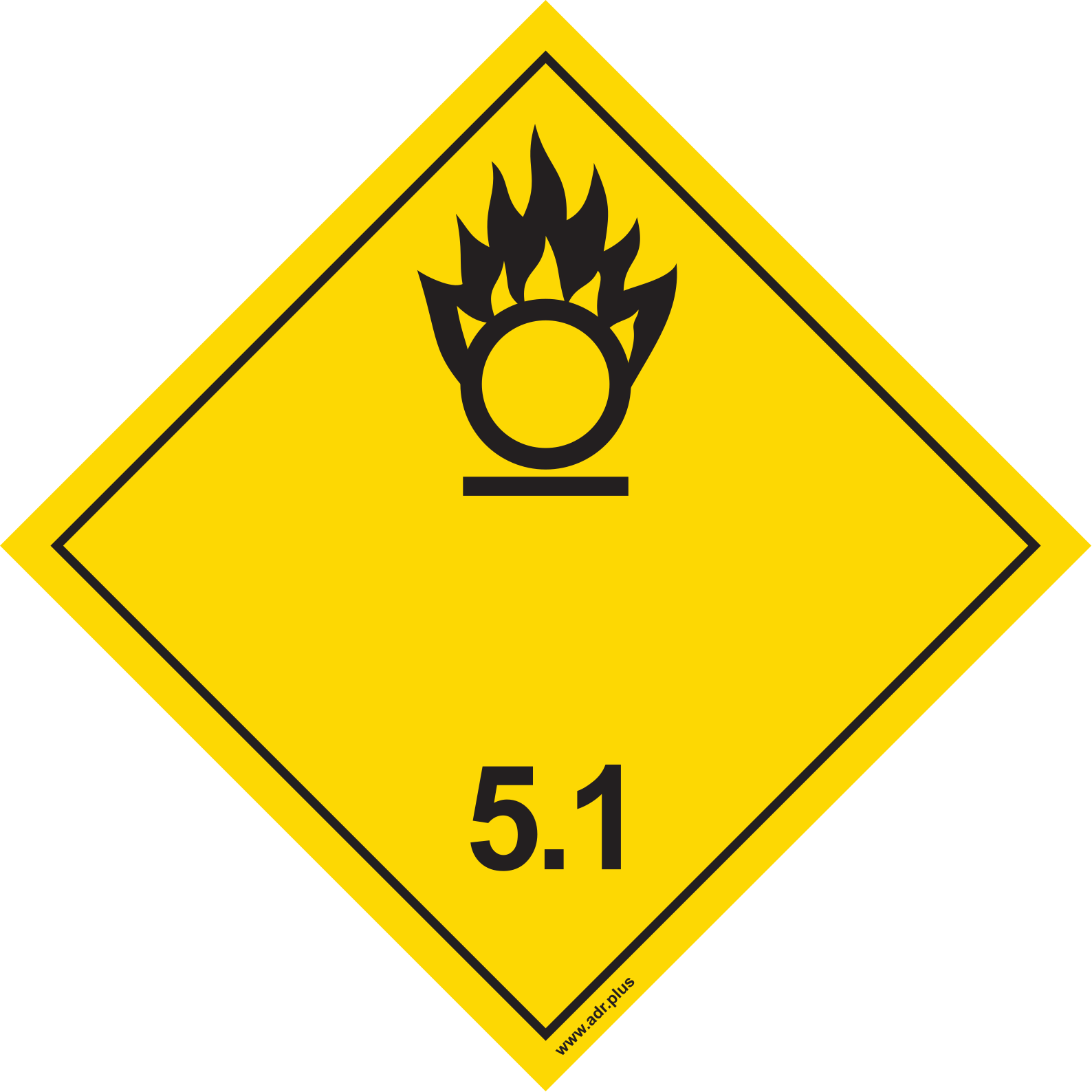
Class 5.1 — oxidizing substances
Substances that may not be combustible themselves but can supply oxygen and so intensify the combustion of other materials.
- Packing groups
- I–III
- UN entries
- 172
What belongs in this class?
Class 5.1 covers substances that, while not necessarily combustible themselves, may — generally by yielding oxygen — cause or contribute to the combustion of other material, along with articles containing them. (ADR 2.2.51.1.1)
The defining behaviour is measured by comparison, not chemistry — a solid is an oxidizer if, mixed with cellulose and tested, it ignites, burns, or burns at least as readily as a reference mixture of potassium bromate (test O.1) or calcium peroxide (test O.3) with cellulose. (ADR 2.2.51.1.6)
Classification rules
- ADR 2.2.51.1.2
The classification code is built on the letter O — O for oxidizers without subsidiary hazard (O1 liquid, O2 solid, O3 articles), with OF flammable, OS self-heating, OW water-reactive, OT toxic, OC corrosive and OTC toxic-corrosive combinations.
- ADR 2.2.51.1.1
Because these substances supply oxygen to a fire, the danger they pose is defined relative to reference oxidizers rather than to their own flammability.
- ADR 2.2.51.1.2
Oxidizers may also carry subsidiary hazards — flammable, self-heating, water-reactive, toxic or corrosive — which the O-code combinations flag directly.
Packing groups in this class
How many UN numbers in this class fall under each packing group.
Oxidizing solids are assigned to packing group I, II or III by how their burning time or burning rate compares with graded reference mixtures. (ADR 2.2.51.1.8)
Under test O.1 the comparison is against potassium-bromate/cellulose mixtures — PG I burns faster than a 3:2 mixture, PG II at least as fast as a 2:3 mixture, PG III at least as fast as a 3:7 mixture — with each higher group taking precedence. Under test O.3 the comparison is against calcium-peroxide/cellulose mixtures on the same graded basis. (ADR 2.2.51.1.8)
Packing group I marks the most aggressive oxidizers and packing group III the mildest — and the more readily a substance accelerates combustion, the stricter its group. This is why oxidizers are kept apart from flammable and combustible goods in loading and stowage.
Class 5.1 in Table A
Transport categories, tunnel codes and quantity reliefs across the 172 Table A entries of this class.
Transport categories
The category feeds the 1.1.3.6 calculation — the lower the number, the stricter the limit.
Tunnel codes
The column 15 code decides which tunnel categories the load may pass.
Limited quantities (LQ)
entries allow LQ
of 172 in the class
For the rest there is no relief — the full ADR applies to any quantity.
Excepted quantities (EQ)
entries allow EQ
of 172 in the class
For the rest there is no relief — the full ADR applies to any quantity.
Marking and signs for Class 5.1
What must be on every package — and what the transport unit carries on the road.
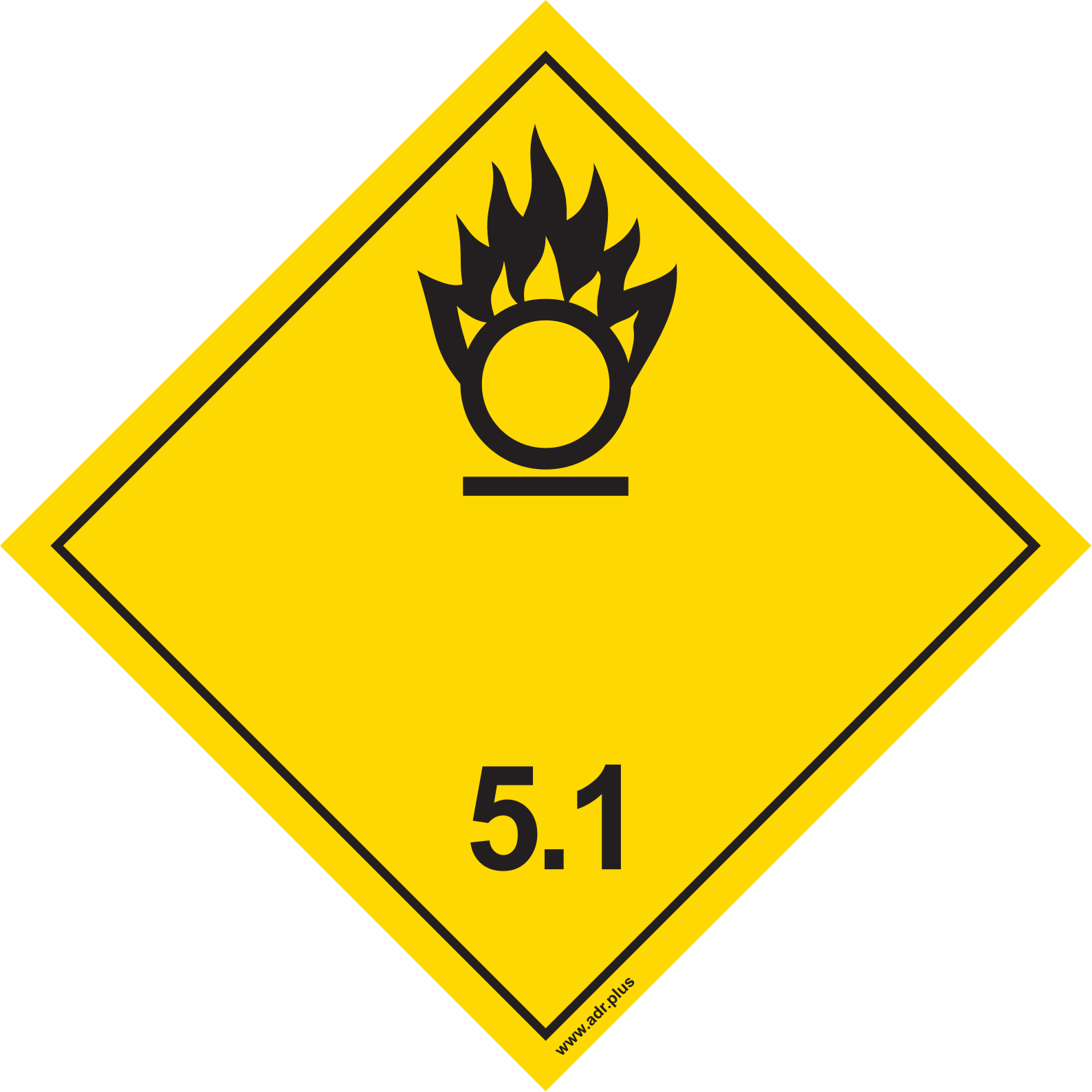
On the package
Every package carries the danger label of its Table A entry and the UN number with the letters "UN" (ADR 5.2.1, 5.2.2).
On the transport unit
Orange plates at the front and rear — and for tanks and bulk also enlarged placards 250 × 250 mm on the sides and rear (ADR 5.3.1, 5.3.2).

Limited quantities
Goods packed under Chapter 3.4 carry the LQ mark instead of the danger label and UN number (ADR 3.4.1, 3.4.7).
Class 5.1 specifics
- ADR 5.2.1.10.1
If the inner packagings of a combination packaging contain liquids, the package must bear orientation arrows — a general rule that applies to goods of all classes.
Transport document
What must be written in the transport document when you ship Class 5.1 goods.
- ADR 5.4.1.1.1
The transport document entry shows the packing group, which may be preceded by the letters PG — for example, UN 1942, AMMONIUM NITRATE, 5.1, PG III, (E).
- ADR 5.4.1.1.6.2.1
For empty packagings, uncleaned, the information of the goods last loaded may be replaced by "WITH RESIDUES OF " followed by the classes and subsidiary hazards in the class numbering order.
Reliefs and restrictions
How much may travel under lighter regimes — and where tunnels restrict the route — is set per UN entry in Table A.
Limited quantities (LQ)
Column 7a caps each inner packaging. Within Chapter 3.4 most ADR requirements fall away, including the driver certificate.
ReadExcepted quantities (EQ)
E codes in column 7b let very small inner receptacles travel with almost no ADR overhead (Chapter 3.5).
ReadTunnel restrictions
Column 15 assigns the tunnel restriction code — it decides which tunnel categories the load may pass.
ReadLook up a Class 5.1 UN number
Get the full ADR profile for any UN number in this class.
Typical UN numbers
All 172 entries
Help with Class 5.1 shipments
Not sure this class applies to you?
A DGSA can confirm the classification before your next load leaves the yard.
Train your team
Awareness training under ADR 1.3 for everyone who consigns, packs or loads dangerous goods.
Browse the courses